

Just Intonation in MeloPresto
Jim Plamondon
1. The goal
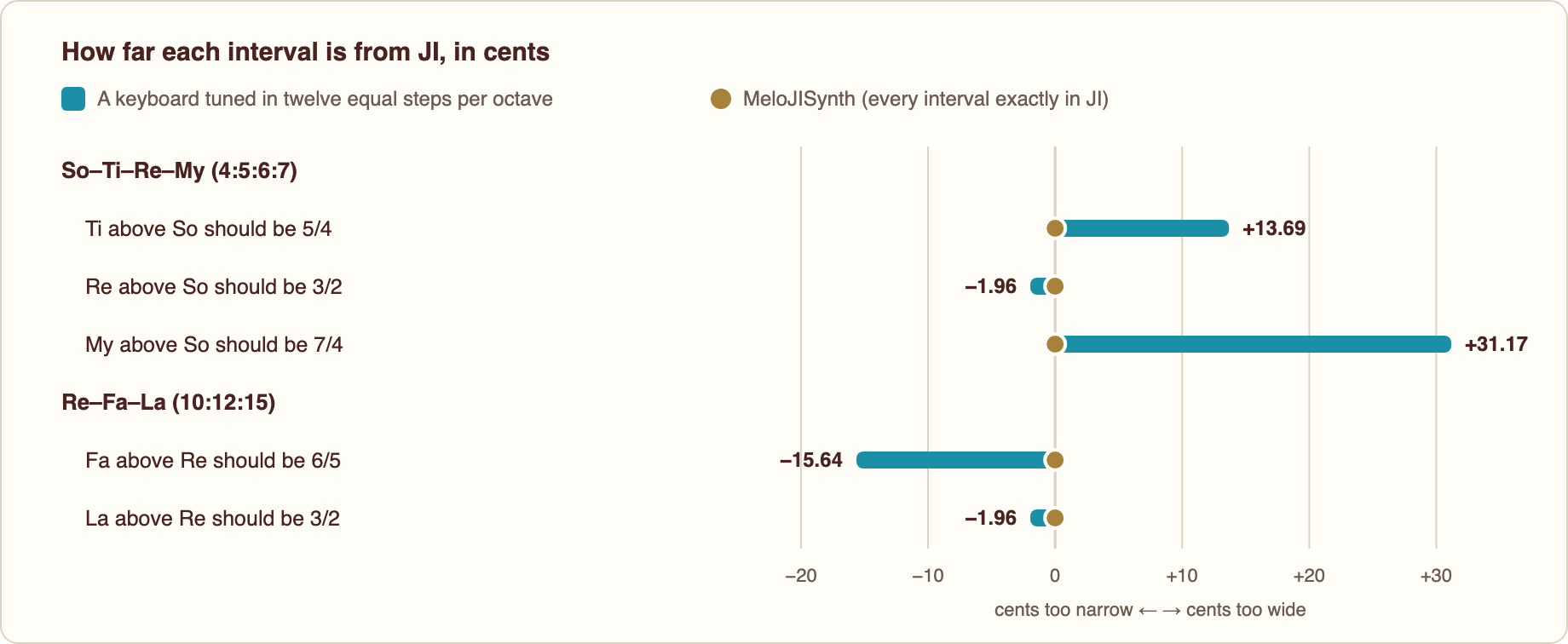
MeloJISynth is a proposed synthesizer for the MeloPresto Music System. The goal of MeloJISynth is to let a player play in JI (just intonation: tuning in which the notes of a chord stand in whole-number frequency ratios, such as 4:5:6), and above all to let the player accompany singers in JI. Singers can adjust their pitches as a chord changes. A keyboard tuned in twelve equal steps per octave cannot match the pure ratios of even an ordinary 4:5:6 major triad. MeloJISynth offers eight tunings so the player can choose pure ratios across the tested repertoire, subject to the limits in sections 5.5 and 8.
The player is a jammist (a person who plays a jammer). A jammer is an instrument with thumb-sticks and a button-field (a grid of note-buttons on which each interval has one shape wherever the jammist plays the interval), as the Thummer was. The jammist chooses the tuning with one thumb-stick (a small joystick moved by the thumb, as on a game controller).
MeloJISynth makes sustained, organ-like sounds with harmonic timbres (sounds whose component frequencies are 1, 2, 3, 4 and so on times the frequency of the note). Chords in JI sound smoothest with harmonic timbres.
MeloJISynth uses just intonation throughout. It draws on Dynamic Tonality, in which tuning can vary continuously and a sound’s overtones can be adjusted to match the tuning (Sethares et al., 2009), without implementing that continuum:
- MeloJISynth has no temperament. Every note sounds at a JI pitch.
- MeloJISynth has no continuum of tunings. The jammist cannot change the width of the fifth or the width of the octave.
- MeloJISynth never changes a timbre to match a tuning. Every timbre is a harmonic timbre.
- Milne’s Tone Diamond is a two-dimensional control that balances tuning regularity, harmonicity of timbre, and consonance. Its Major JI and Minor JI settings provide the starting maps for MeloJISynth (Milne, 2007, §3 and Figure 7). MeloJISynth does not implement the Tone Diamond: its thumb-stick selects eight discrete states derived from or closely related to those maps, with the extensions described in sections 3–5.
MeloJISynth draws on Dynamic Tonality for both the note-to-ratio mapping and the construction of its control-states. As Milne showed, on the Thirteen Notes, each state matches or closely matches a Dynamic Tonality major or minor tuning map whose reference note has been moved. The differences matter: MeloJISynth chooses eight discrete tunings and trades smaller changes between some states for more coverage of pure chords. It does not implement the Tone Diamond or the Dynamic Tonality continuum. Sections 3–5 give the mapping and the differences.
2. The eight control-states
2.1 Note names
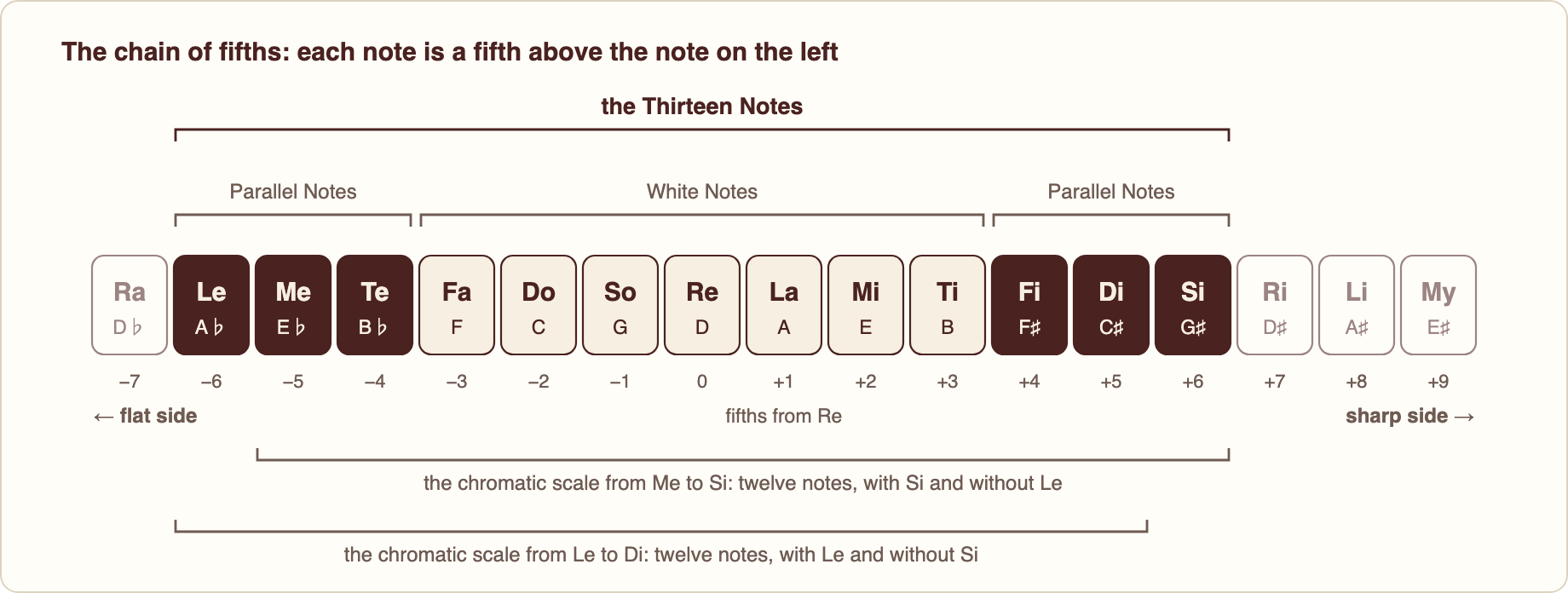
MeloPresto names notes with movable-Do syllables. Re corresponds to D in Milne’s example (2007, §1). The table lists the notes along the chain of fifths (the order of note names in which each note is a fifth above the note before).
| MeloPresto name | Ra | Le | Me | Te | Fa | Do | So | Re | La | Mi | Ti | Fi | Di | Si | Ri | Li | My |
|---|---|---|---|---|---|---|---|---|---|---|---|---|---|---|---|---|---|
| Letter name when Re is D | D♭ | A♭ | E♭ | B♭ | F | C | G | D | A | E | B | F♯ | C♯ | G♯ | D♯ | A♯ | E♯ |
The flat side is the part of the chain of fifths to the left of Re. The sharp side is the part of the chain of fifths to the right of Re.
The Thirteen Notes are the notes from Le to Si: six fifths on the flat side of Re, Re, and six fifths on the sharp side of Re. The Thirteen Notes are the seven White Notes (Fa, Do, So, Re, La, Mi and Ti: the notes F, C, G, D, A, E and B) and the six Parallel Notes (Te, Me and Le on the flat side; Fi, Di and Si on the sharp side). The Thirteen Notes are also the two twelve-note chromatic scales centred on Re, taken together: the chromatic scale from Me to Si, which has Si and lacks Le, and the chromatic scale from Le to Di, which has Le and lacks Si.
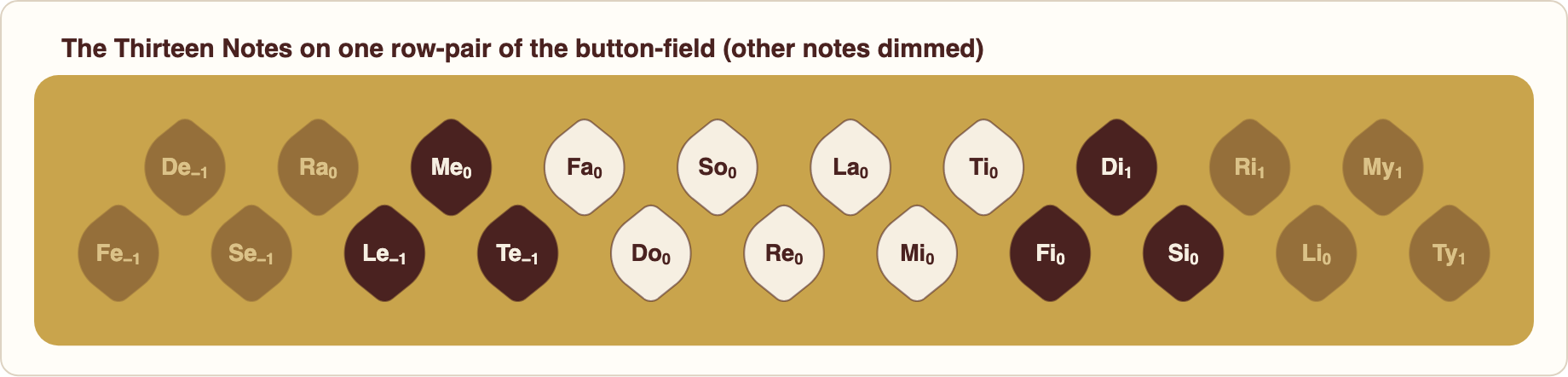
MeloJISynth is designed for chords made from the Thirteen Notes. A jammist reaches chords on other notes by changing key.
2.2 Terms
- Unless otherwise specified, comma means the syntonic comma, the ratio 81/80 (21.51 cents).
- The Reference Pitch is the pitch that the jammist or the score assigns to Re. The upper and lower Re pitches are measured from it.
- A resting pitch is the pitch at which a note sounds when no control-state moves the note. Within fewer than 17 fifths of Re, only Re has two candidates: upper Re is half a comma above the Reference Pitch and lower Re half a comma below it. At 17 fifths from Re, another note reaches the strip’s boundary and can also have two candidates. Each control-state still assigns one pitch to each note.
- A 7/4 pitch is a pitch exactly 7/4 (968.83 cents) above or below another named note. A note assigned a 7/4 pitch uses that ratio instead of its resting pitch; section 5.4 says which notes are assigned a 7/4 pitch in each state.
- A chord is pure when every interval between two notes of the chord is exactly the whole-number ratio written beside the chord.
- A control-state is a rule that gives every note exactly one pitch. MeloJISynth has eight control-states.
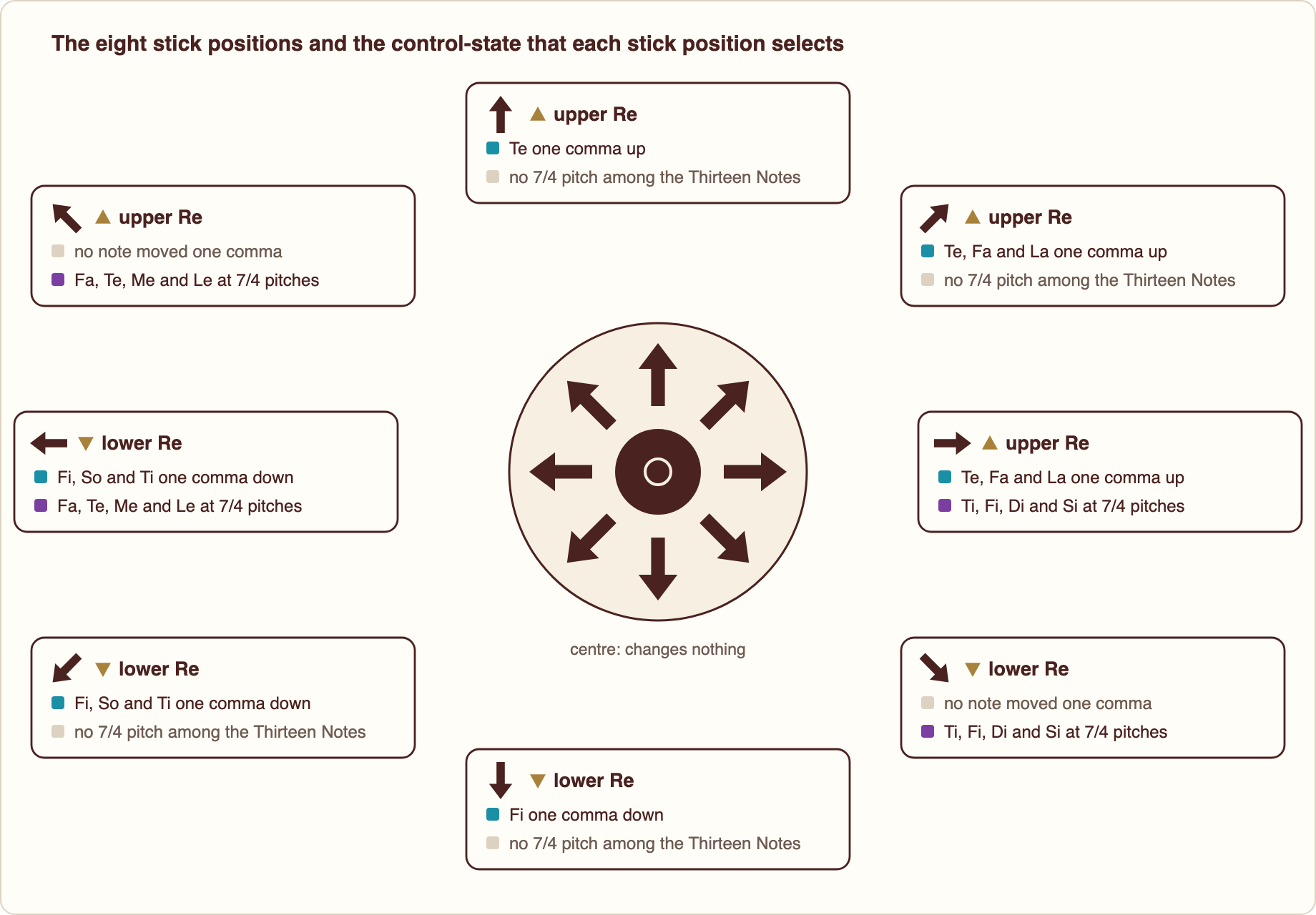
- A stick position is one of the eight directions in which the jammist can push the thumb-stick: up, down, left, right and the four diagonals. Each stick position selects one control-state.
2.3 How the jammist selects a control-state
The jammist pushes the thumb-stick to a stick position. MeloJISynth changes to the control-state of the stick position at once. The control-state stays in force after the thumb-stick returns to the centre. The control-state changes only when the jammist pushes the thumb-stick to a different stick position.
2.4 The table of control-states
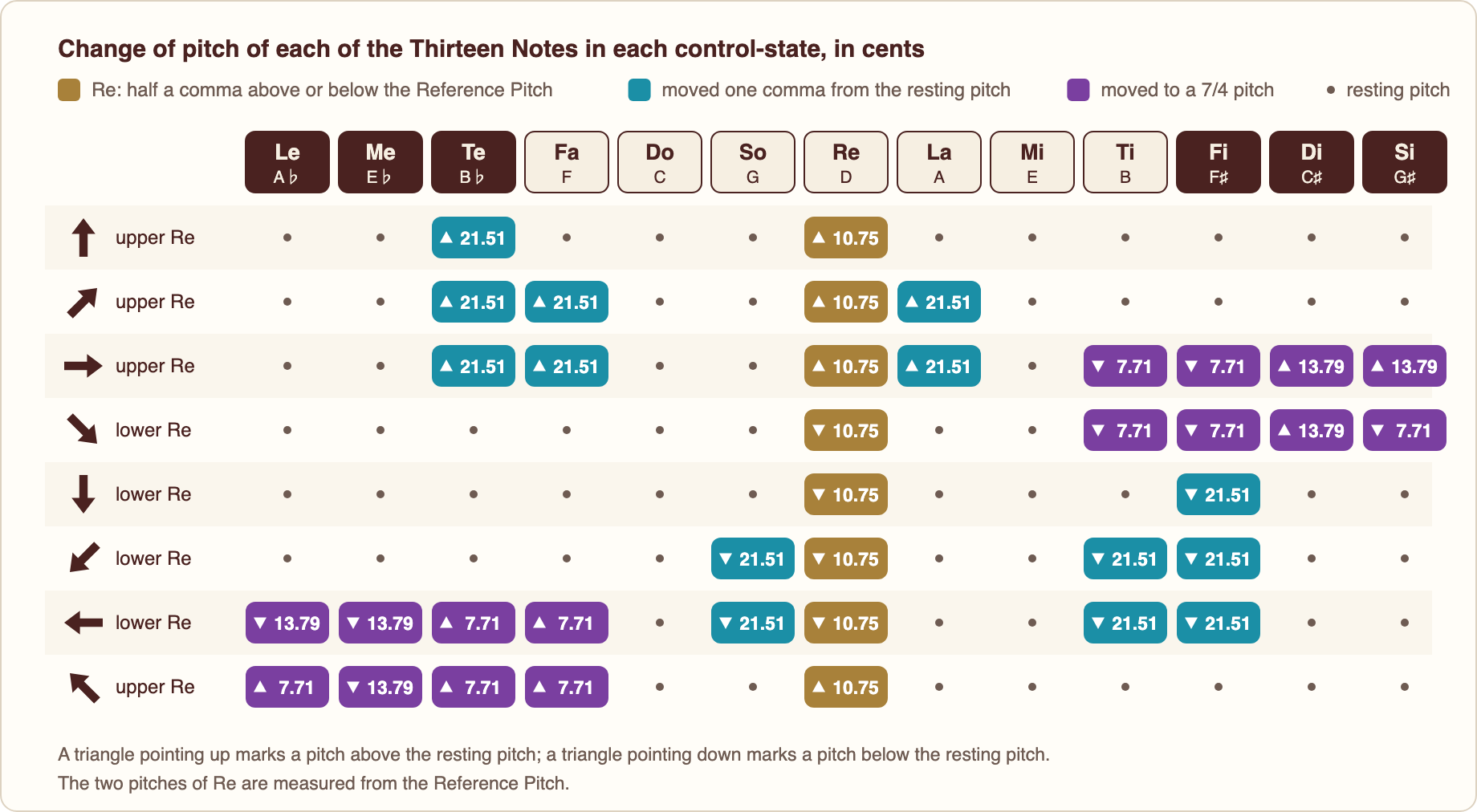
| Stick position | Re | Notes moved one comma from the resting pitch | Notes moved to a 7/4 pitch | Examples of chords that the control-state makes pure |
|---|---|---|---|---|
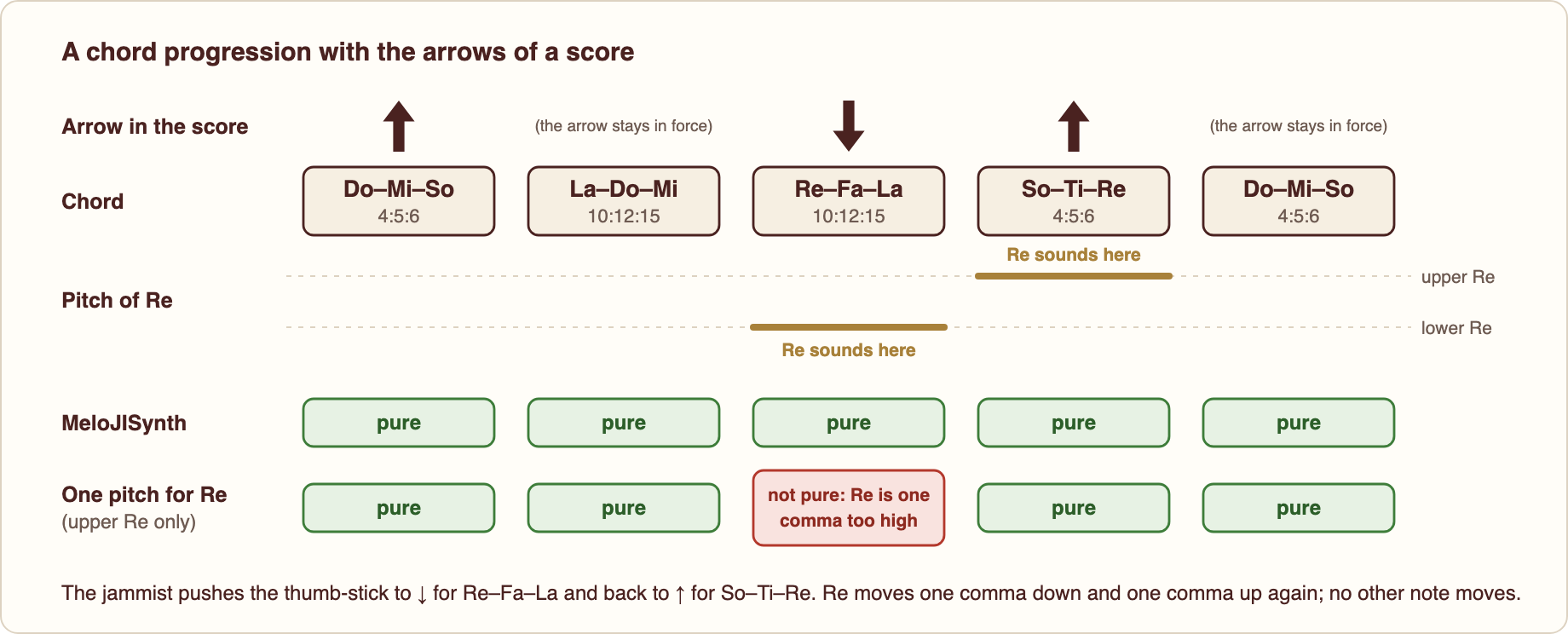
| ↑ | upper Re | Te up | none of the Thirteen Notes | So–Ti–Re (4:5:6); Mi–So–Ti–Re (10:12:15:18); So–Ti–Re–My (4:5:6:7) |
| ↗ | upper Re | Te, Fa and La up | none of the Thirteen Notes | So–Ti–Re–Fa (20:25:30:36); So–Ti–Re–Fa–La (20:25:30:36:45) |
| → | upper Re | Te, Fa and La up | Ti, Fi, Di and Si (7/4 above Ra, Le, Me and Te) | Me–So–Te–Di (4:5:6:7); Te–Re–Fa–Si (4:5:6:7) |
| ↘ | lower Re | none | Ti, Fi, Di and Si (7/4 above Ra, Le, Me and Te) | Le–Do–Me–Fi (4:5:6:7); Te–Re–Fa–Si (4:5:6:7) |
| ↓ | lower Re | Fi down | none of the Thirteen Notes | Re–Fa–La (10:12:15); Re–Fa–La–Do (10:12:15:18) |
| ↙ | lower Re | Fi, So and Ti down | none of the Thirteen Notes | Ti–Re–Fa–La (25:30:36:45); Ti–Re–Fa–La–Do (25:30:36:45:54) |
| ← | lower Re | Fi, So and Ti down | Fa, Te, Me and Le (7/4 below Ri, Si, Di and Fi) | Le–Ti–Re–Fi (60:70:84:105); Me–Fi–La–Di (60:70:84:105) |
| ↖ | upper Re | none | Fa, Te, Me and Le (7/4 below Ri, Si, Di and Fi) | Le–Ti–Re–Fi (60:70:84:105); Te–Di–Mi–Si (60:70:84:105) |
Three facts summarize the table:
- The four stick positions ↖, ↑, ↗ and → select upper Re. The four stick positions ↘, ↓, ↙ and ← select lower Re.
- The two stick positions → and ↘ move four notes of the sharp side to 7/4 pitches. The two stick positions ← and ↖ move four notes of the flat side to 7/4 pitches.
- Do and Mi sound at the resting pitch in all eight control-states.
3. Why Re has two pitches
MeloJISynth’s resting pitches follow Milne’s reverse mapping (2007, §1). In the JI lattice, a grid of ratios built from 3/2 and 5/4, many ratios one syntonic comma apart can map to the same note name. Milne selects a strip one comma wide, with an edge through the reference tone. An interior note has one candidate; a boundary note can have two, one syntonic comma apart. Milne (2026, §1.1) derives the location of the strip’s centre half a comma from the reference note. That placement makes the two maps mirror images, gives them the same pitch off the boundary, and puts an edge through the reference note.
In MeloJISynth the reference tone is Re. In the baseline 5-limit maps (whole-number ratios using the primes 2, 3 and 5), the Dynamic Tonality major map, also called the otonal map, has upper Re. Its mirror, the minor or utonal map, has lower Re. Measured from the centre, the two Re pitches are ±10.7531 cents from the Reference Pitch. Within the Thirteen Notes the two baseline maps differ only at Re. This is not the same as switching between MeloJISynth’s ↑ and ↓, which also changes Te and Fi. Milne calls the rule that selects a ratio for each note the privileged preimage.
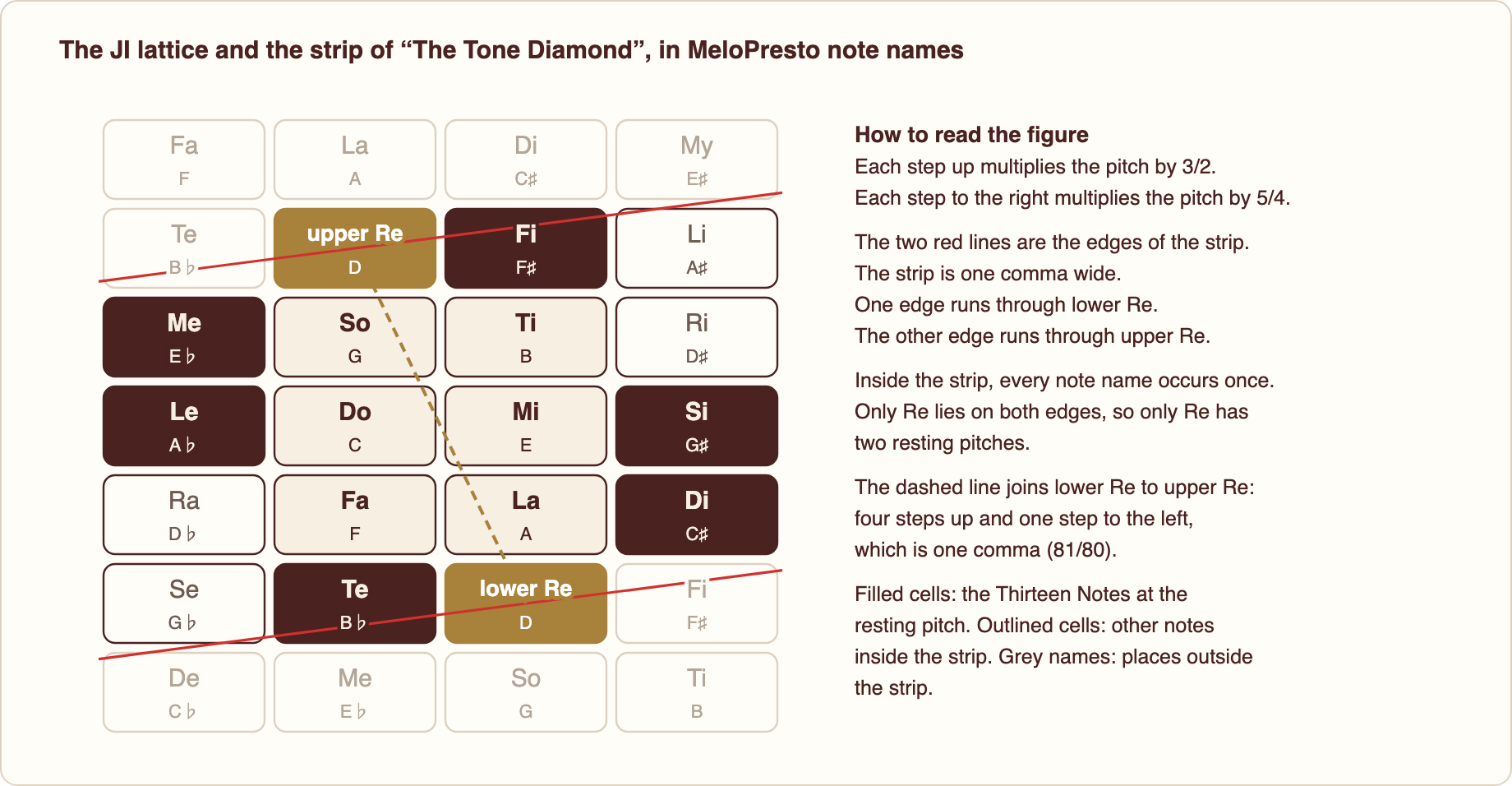
The rule for a resting pitch is short. For a note k fifths from Re along the chain of fifths, start k ratios of 3/2 above the Reference Pitch, lower the result by ⌊4k/17⌋ + ½ commas, and bring the result into one octave. Each resting pitch is therefore one simple ratio from the Reference Pitch, plus or minus half a comma (10.7531 cents).
| Note | Fifths from Re | Resting pitch, as a ratio from the Reference Pitch | Resting pitch, in cents above the Reference Pitch |
|---|---|---|---|
| Le | −6 | 36/25 − ½ comma | 620.5294 |
| Me | −5 | 16/15 + ½ comma | 122.4844 |
| Te | −4 | 8/5 − ½ comma | 802.9331 |
| Fa | −3 | 6/5 − ½ comma | 304.8881 |
| Do | −2 | 9/5 − ½ comma | 1006.8431 |
| So | −1 | 4/3 + ½ comma | 508.7981 |
| Re | 0 | 1/1 − ½ comma (lower Re) or 1/1 + ½ comma (upper Re) | −10.7531 or +10.7531 |
| La | +1 | 3/2 − ½ comma | 691.2019 |
| Mi | +2 | 9/8 − ½ comma | 193.1569 |
| Ti | +3 | 5/3 + ½ comma | 895.1119 |
| Fi | +4 | 5/4 + ½ comma | 397.0669 |
| Di | +5 | 15/8 − ½ comma | 1077.5156 |
| Si | +6 | 25/18 + ½ comma | 579.4706 |
4. Why other notes move one comma
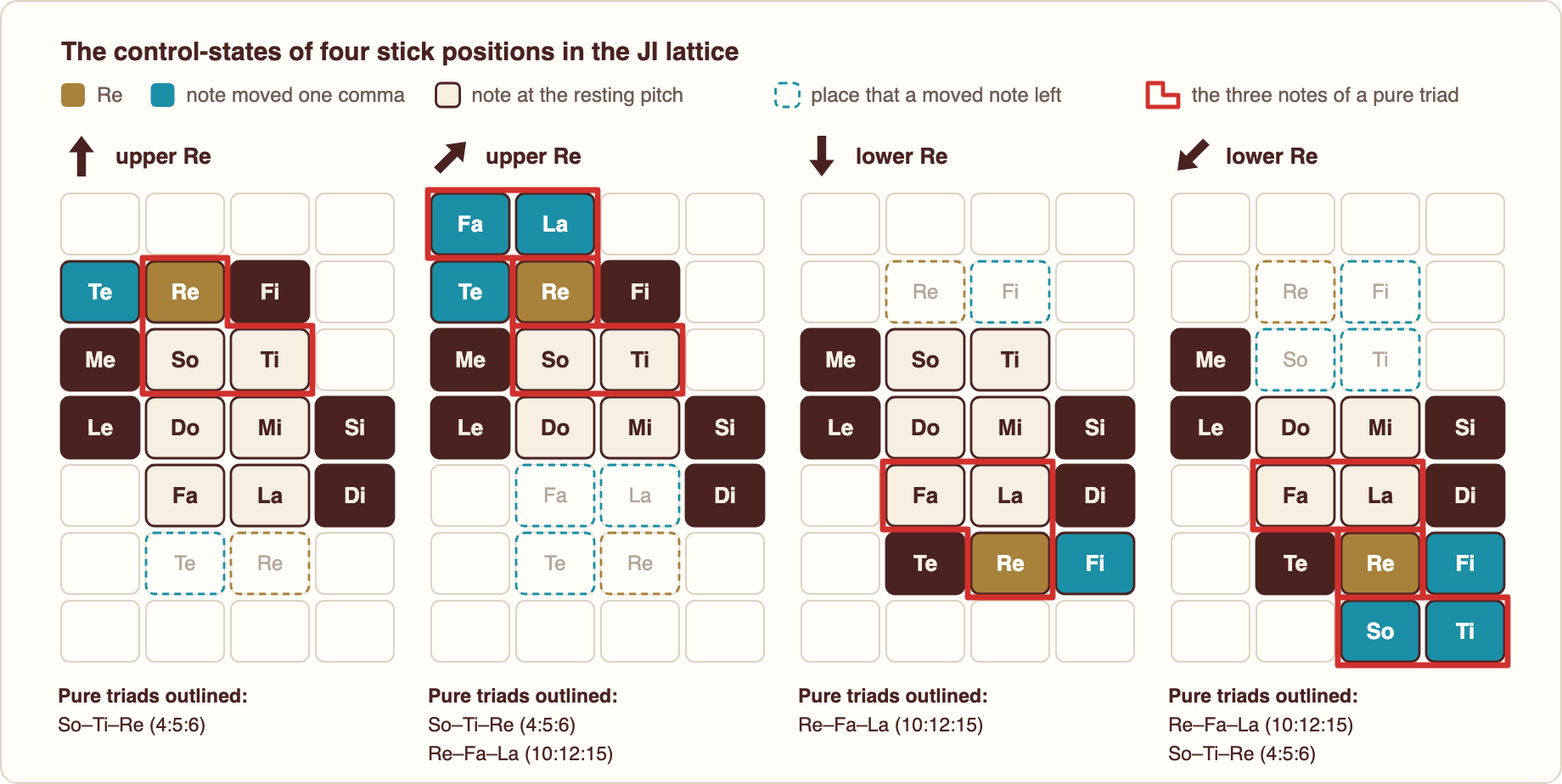
Within the Thirteen Notes, Milne’s baseline major and minor maps differ only at Re (2026, §1.1). Moving Re alone makes 11 of the 14 triads and seventh chords of the White Notes pure: a chord that holds So needs upper Re, and a chord that holds La needs lower Re. The other three chords (Ti–Re–Fa, So–Ti–Re–Fa and Ti–Re–Fa–La) hold both Fa and Ti. Two intervals of 6/5 make 36/25. The interval from the resting pitch of Ti up to the resting pitch of Fa is 64/45, one comma narrower than 36/25. A chord that holds both Fa and Ti is therefore pure only when a second note moves one comma.
A search answered the question of how many control-states the chords need. The search covered every triad, seventh chord, ninth chord, eleventh chord and thirteenth chord on each of the seven notes of three collections: the White Notes; the Parallel Minor Notes (Le, Me, Te, Fa, Do, So and Re: the pattern of the White Notes placed three fifths toward the flat side); and the Parallel Major Notes (Re, La, Mi, Ti, Fi, Di and Si: the pattern of the White Notes placed three fifths toward the sharp side). The three collections hold 105 chords: 63 triads, sevenths and ninths, plus 42 elevenths and thirteenths. Milne found that either of two three-state sets (up, up-right and down-left; or up-right, down and down-left) makes all 63 smaller chords pure across its states. This shows that four states are not needed for those 63; it does not show that three is the minimum. The 42 larger chords need a stated criterion for comparing compromises before one can test whether a fourth state is required (section 8). The design retains ↑, ↗, ↓ and ↙.
- ↑ and ↓. The control-state of ↑ is Milne’s baseline major map with Te moved up one comma, so that So–Te–Re is pure (10:12:15). The control-state of ↓ is Milne’s baseline minor map with Fi moved down one comma, so that Re–Fi–La is pure (4:5:6).
- ↗ and ↙. In the control-state of ↗, Fa and La move up one comma to meet upper Re, so that Re–Fa–La is pure (10:12:15) while So–Ti–Re stays pure (4:5:6). In the control-state of ↙, So and Ti move down one comma to meet lower Re, so that So–Ti–Re is pure while Re–Fa–La stays pure.
- Mirror symmetry. The moves are mirror images about Re: Te up mirrors Fi down, Fa up mirrors Ti down, and La up mirrors So down.
- No knowledge of the collection. Coverage of the 63 smaller chords spans all three collections without telling the synth which collection is in use. The player still chooses the state.
5. Why some notes move to a 7/4 pitch
5.1 Which note name carries 7/4
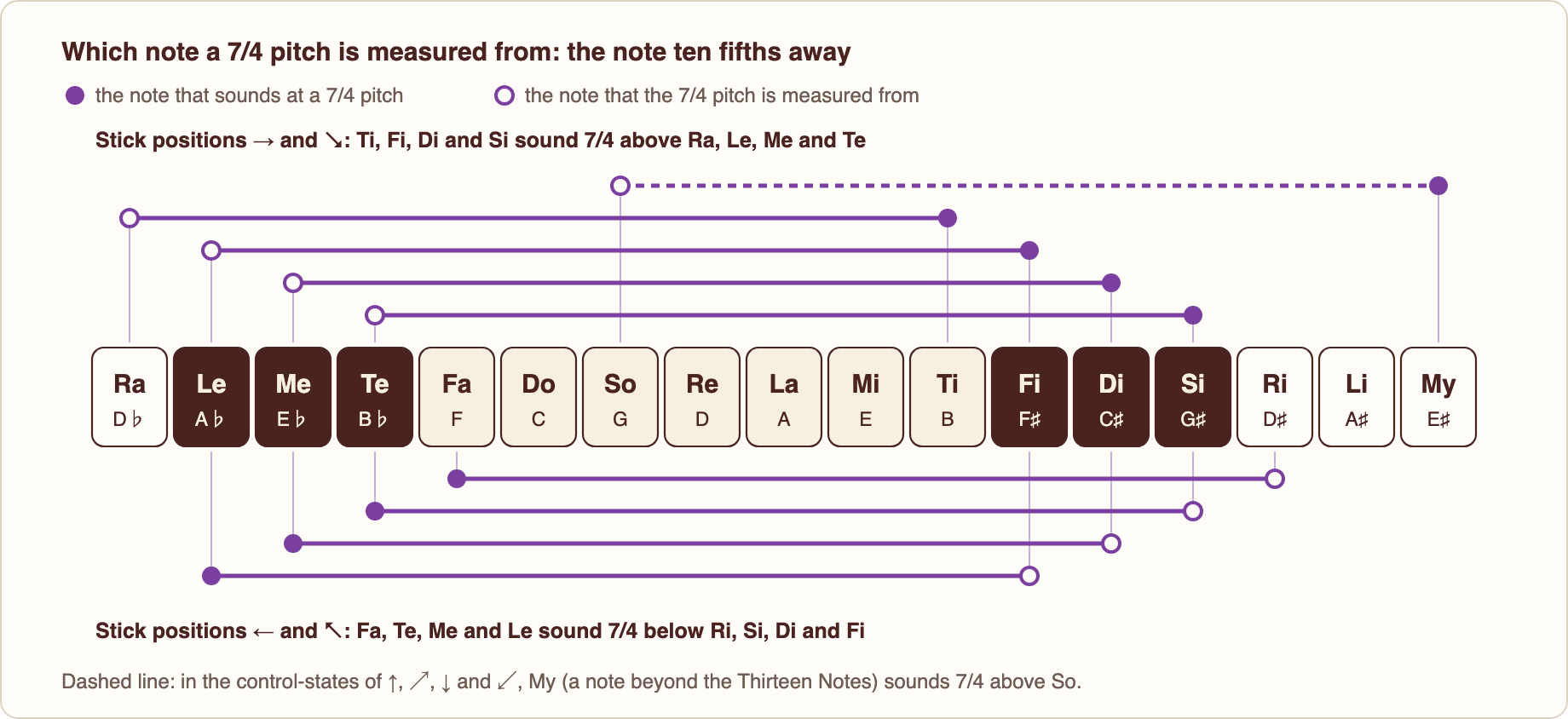
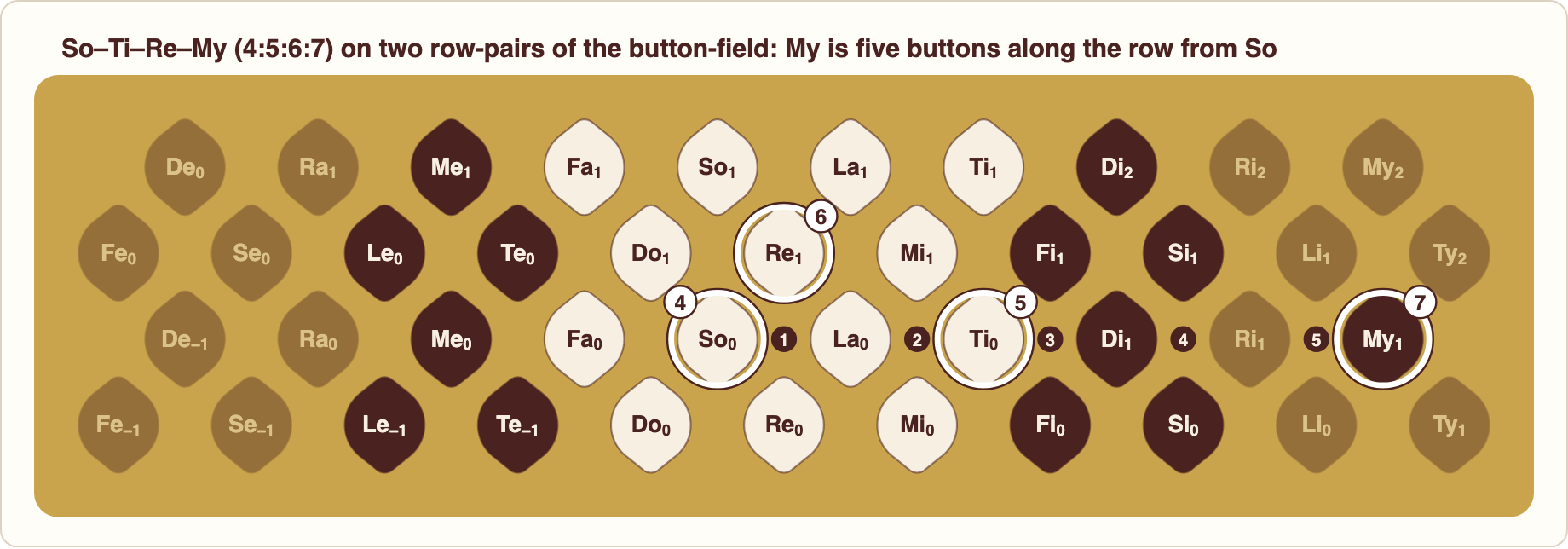
MeloPresto assigns ratios to note names by counting fifths along the chain of fifths. The ratio 3/2 is one fifth along the chain of fifths (Re to La). The ratio 5/4 is four fifths along the chain of fifths (Re to Fi), as in Milne’s mapping (2007, §1). The ratio 7/4 maps to ten fifths, with octave adjustment, as in septimal meantone (the mapping that also includes the prime 7). That correspondence determines the note name, not the exact pitch selected by each tuning map. The note 7/4 above So is therefore My (E♯ above G), as in 31-edo (the tuning that divides the octave into 31 equal steps). The chord 4:5:6:7 on So is So–Ti–Re–My, not So–Ti–Re–Fa. On the button-field, the note 7/4 above any note is five buttons along the row of the note.
A note on the sharp side at a 7/4 pitch sounds 7/4 above the note ten fifths toward the flat side. A note on the flat side at a 7/4 pitch sounds 7/4 below the note ten fifths toward the sharp side.
5.2 Why four control-states have 7/4 pitches
Two kinds of chord need a 7/4 pitch:
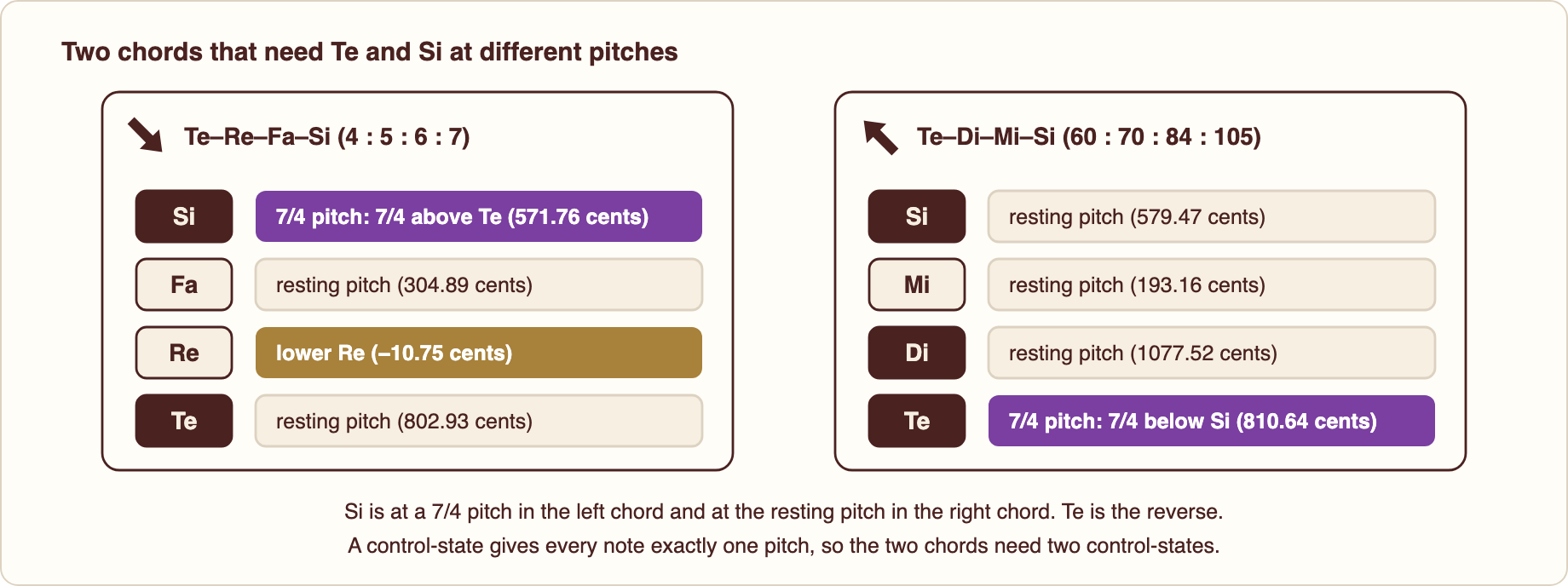
- The chord 4:5:6:7 and the parts of the chord 4:5:6:7 need one note of the sharp side at a 7/4 pitch, while the notes of the flat side sound at the resting pitch. Example: Te–Re–Fa–Si, in which Si sounds 7/4 above Te.
- The mirror chord (the utonal tetrad: the chord 4:5:6:7 turned upside down, with the ratios 60:70:84:105) needs one note of the flat side at a 7/4 pitch, while the notes of the sharp side sound at the resting pitch. Example: Te–Di–Mi–Si, in which Te sounds 7/4 below Si.
One control-state cannot serve both kinds of chord, because a control-state gives every note exactly one pitch. In Te–Re–Fa–Si, Te sounds at the resting pitch and Si sounds at a 7/4 pitch. In Te–Di–Mi–Si, Si sounds at the resting pitch and Te sounds at a 7/4 pitch. MeloJISynth therefore has two control-states that move Ti, Fi, Di and Si to 7/4 pitches (→ and ↘), and two control-states that move Fa, Te, Me and Le to 7/4 pitches (← and ↖).
5.3 The 7/4 pitches
For the changes in the table below, the 7/4 pitch differs from the resting pitch by 7.71 cents (225/224) or 13.79 cents (126/125). Like 81/80, both ratios are commas of septimal meantone. Moving a note to a 7/4 pitch and moving it by a syntonic comma are the same kind of change: both select a different ratio for the same named note.
| Note | The note sounds 7/4 | Stick position | 7/4 pitch, in cents above the Reference Pitch | Change from the resting pitch |
|---|---|---|---|---|
| Ti | above Ra | → and ↘ | 887.4003 | 7.71 cents down |
| Fi | above Le | → and ↘ | 389.3553 | 7.71 cents down |
| Di | above Me | → and ↘ | 1091.3103 | 13.79 cents up |
| Si | above Te, with Te one comma up | → | 593.2653 | 13.79 cents up |
| Si | above Te, with Te at the resting pitch | ↘ | 571.7590 | 7.71 cents down |
| Fa | below Ri | ← and ↖ | 312.5997 | 7.71 cents up |
| Te | below Si | ← and ↖ | 810.6447 | 7.71 cents up |
| Me | below Di | ← and ↖ | 108.6897 | 13.79 cents down |
| Le | below Fi, with Fi one comma down | ← | 606.7347 | 13.79 cents down |
| Le | below Fi, with Fi at the resting pitch | ↖ | 628.2410 | 7.71 cents up |
In the control-state of ↘, Fi sounds at a 7/4 pitch, so Fi is not one comma down as Fi is in the control-state of ↓. In the control-state of ↖, Te sounds at a 7/4 pitch, so Te is not one comma up as Te is in the control-state of ↑.
5.4 Notes beyond the Thirteen Notes
In the four control-states of ↑, ↗, ↓ and ↙, none of the Thirteen Notes sounds at a 7/4 pitch. The notes beyond the Thirteen Notes sound at 7/4 pitches: each note beyond Si sounds 7/4 above the note ten fifths toward the flat side, and each note beyond Le sounds 7/4 below the note ten fifths toward the sharp side. My therefore sounds 7/4 above So, and So–Ti–Re–My is pure (4:5:6:7) in the control-states of ↑, ↗ and ↙.
- → and ↘: Each note beyond Si sounds 7/4 above the note ten fifths toward the flat side. Each note beyond Le stays at its resting pitch.
- ← and ↖: Each note beyond Le sounds 7/4 below the note ten fifths toward the sharp side. Each note beyond Si stays at its resting pitch.
In each case use the anchor note’s pitch in the selected state, with octave adjustment. The directional rule applies to the outer notes as well as to the named changes within the Thirteen Notes in section 5.3.
5.5 The chords examined
A second search covered 472 chords: the 105 chords of section 4; 355 placements of the 23 chord shapes that contain a 7 and in which every interval between two notes is a ratio of two of the numbers 1, 3, 5, 7 and 9, allowing octaves; and the 12 placements of the six-note chord whose notes are the products of two of the numbers 1, 3, 5 and 7. The search for the 355 and 12 placements used a chain of 25 notes, twelve fifths on each side of Re and Re itself; this is wider than the 21 notes of a single row-pair. Milne reproduced the counts and verified that all 430 chords other than the 42 elevenths and thirteenths are pure in at least one of the eight states when the directional rule in section 5.4 is used. If the outer notes are instead left at their resting pitches in →, ↘, ← and ↖, 56 of those 430 chords are pure in none of the states. No “best possible” result is claimed for the 42.
5.6 How the eight states compare with the Dynamic Tonality maps
Milne compared the pitches on the Thirteen Notes with Dynamic Tonality maps moved to other reference notes. A match in this table is a match of actual pitches in that range, not just of note names.
| Stick position | Dynamic Tonality comparison | Matches among the Thirteen Notes |
|---|---|---|
| ↑ | 5-limit major map moved to Te | 13 of 13 |
| ↓ | 5-limit minor map moved to Fi | 13 of 13 |
| ↗ | 5-limit major map moved to Fa | 12 of 13; Di is a syntonic comma lower in MeloJISynth |
| ↙ | 5-limit minor map moved to Ti | 12 of 13; Me is a syntonic comma higher in MeloJISynth |
| ↘ | 7-limit major map moved to Me | 12 of 13 |
| ↖ | 7-limit minor map moved to Di | 12 of 13 |
| → | 7-limit major map moved to Fa | 11 of 13 |
| ← | 7-limit minor map moved to Ti | 11 of 13 |
The trade-off is visible even without moving the reference note. Within the Thirteen Notes, ↑ and ↓ each make 14 of the 18 major and minor triads pure; each baseline Dynamic Tonality map at Re makes 12 pure. Together ↑ and ↓ cover all 18; the two baseline 5-limit maps together cover 14. Switching between ↑ and ↓ changes three of the Thirteen Notes; switching between the baseline 5-limit maps changes only Re.
A possible simpler design would use four Dynamic Tonality maps at Re: major and minor at each of the 5- and 7-limits. It is an alternative, not an equivalent replacement. For example, on a 21-note row-pair, the two baseline Dynamic Tonality 7-limit maps together make 6 of 22 otonal and utonal tetrad placements pure, compared with all 22 across the eight MeloJISynth states.
Even where a 7/4 note name agrees, the pitches may differ. Of the eight notes beyond the Thirteen Notes on a 21-note row-pair, ↑ agrees with the baseline 7-limit major map at De, Se, Ra, Li and My, but not Fe, Ri or Ty. The corresponding ↓ comparison with the baseline 7-limit minor map agrees at De, Se, Ri, Li and My, but not Fe, Ra or Ty. At the differing notes the baseline map keeps the 5-limit pitch where MeloJISynth uses a 7/4 pitch.
6. How the control-states are assigned to stick positions
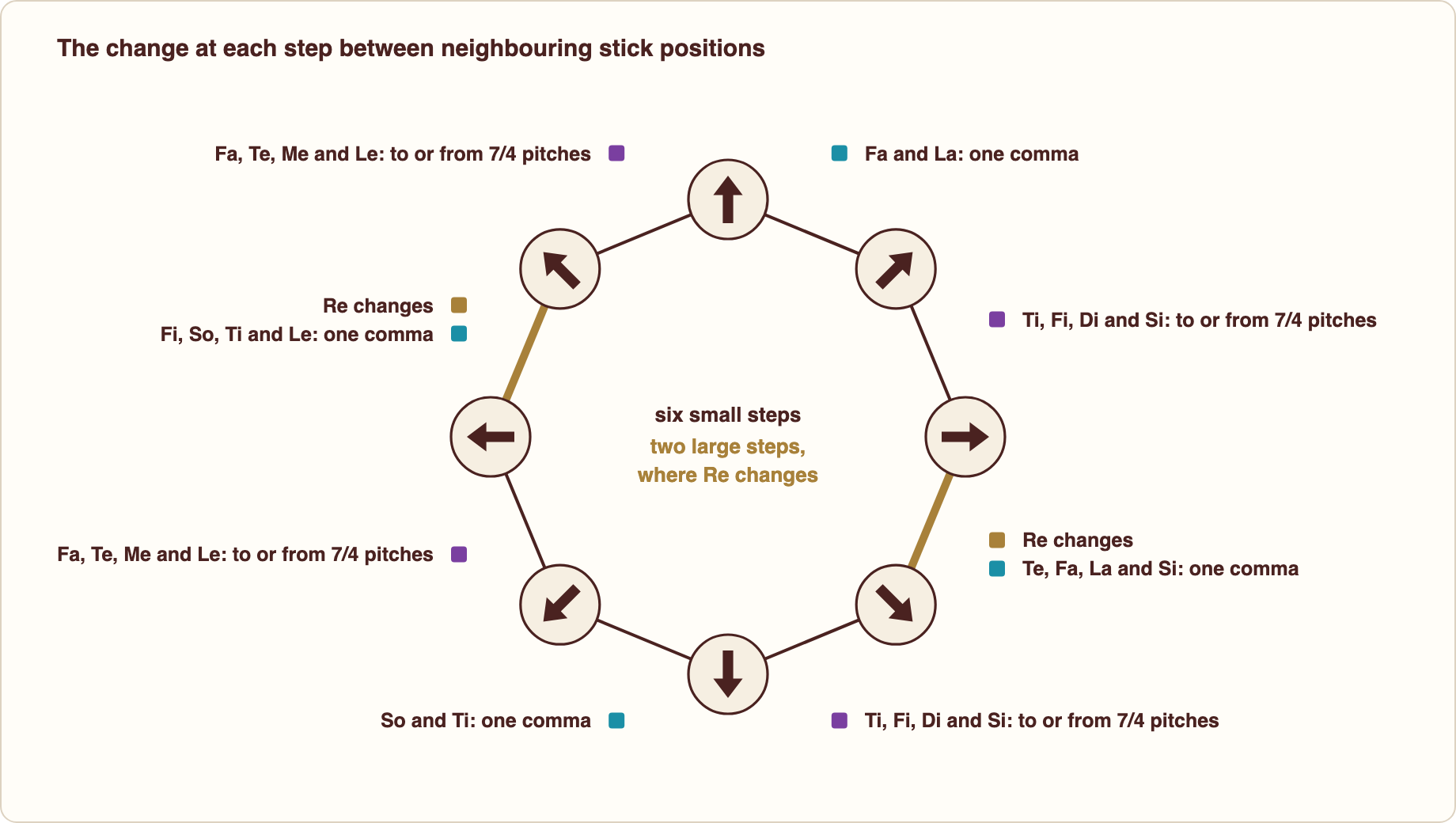
The order around the thumb-stick is ↑, ↗, →, ↘, ↓, ↙, ←, ↖ and back to ↑. Moving directly between ↑ and ↓ changes only Re among the White Notes. Within the Thirteen Notes it also changes Te and Fi.
- Upper Re is on ↑ and lower Re on ↓. In a full turn around the ring, Re changes twice, at → to ↘ and ← to ↖. It is not the most frequently changed note: Fa and Ti each change on four steps.
- Sharpward is on the right and flatward on the left, as on the button-field. The stick positions on the right raise selected notes by a syntonic comma (↗) or assign 7/4 pitches on the sharp side (→ and ↘). The positions on the left lower selected notes by a syntonic comma (↙) or assign 7/4 pitches on the flat side (← and ↖).
- The ring minimizes total pitch movement among orderings of these eight states. The comparison adds the absolute pitch change, in cents, for every note at every step, including the step back to ↑. Checking every ordering with ↑ fixed as the start gave the same minimum for the current ring and its reverse, on each of the three note ranges below. This comparison does not establish that the eight states themselves are the best possible set.
| Note range | Notes changing per adjacent step | Total movement around the ring |
|---|---|---|
| Thirteen Notes | 2, 4 or 5 | 473.14 cents |
| 21-note row-pair | 4, 7 or 8 | 792.91 cents |
| 25-note chain used for the coverage test | 5, 8 or 10 | 940.62 cents |
On the Thirteen Notes, six steps each move either two notes by a syntonic comma or four notes as they switch to or from 7/4 pitches. Each of those steps totals 43.01 cents. At → to ↘ and ← to ↖, five notes move, totaling 107.53 cents per step. The two steps that move Re still have the largest total movement on the 25-note chain (172.05 cents each), even though some other steps move more notes. The outer-note rule in section 5.4 accounts for the additional changes.
7. How a score shows the control-state
A score shows the control-state as an arrow above the staff. The arrow points in the direction of the stick position. An arrow stays in force until the next arrow. A score begins with an arrow, and the jammist pushes the thumb-stick to the stick position of the first arrow before starting to play, as a player chooses a sound before starting to play.
8. The tuning trade-off in elevenths and thirteenths
The ideal ratios can conflict. In Do–Mi–So–Ti–Re–Fa, making each of the five stacked thirds pure gives a root-to-top ratio of 27/10. A pure eleventh would be 8/3. The two differ by 81/80, so this chord cannot satisfy both requirements at once.
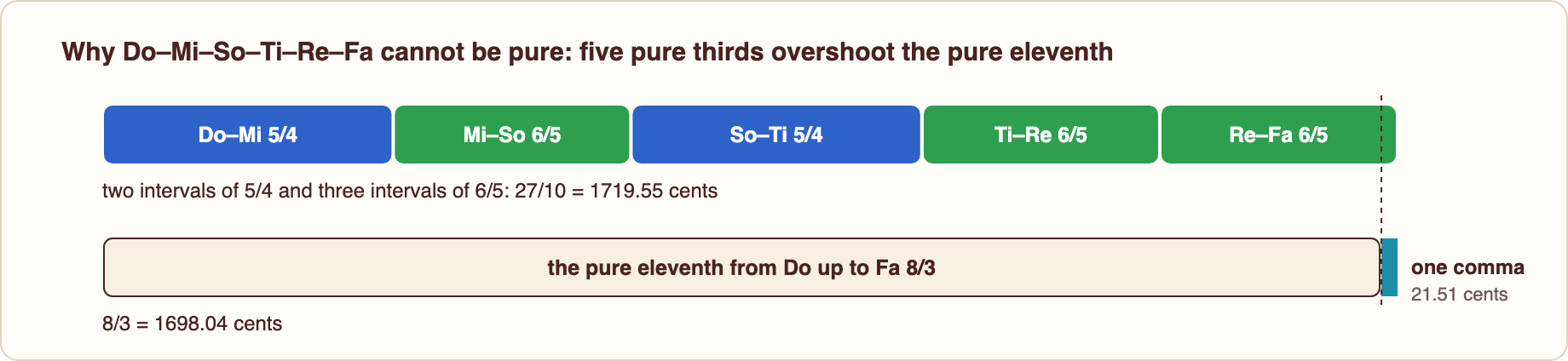
On the White Notes, Milne found that the only stacked third that can be impure in the baseline 5-limit major map at Re is Re–Fa. In the baseline minor map the corresponding third is Ti–Re. Some chords avoid an impure stacked third by accepting an impure eleventh. His examples are the eleventh chord on La in the major map and on Re in the minor map.
These examples show different compromises. They do not prescribe a preferred tuning by chord root or by voicing, and Milne knows of no such rule. The design has not yet specified how to weigh a pure fifth, a pure stacked third and a pure interval from root to top against one another. The 42 elevenths and thirteenths are therefore not included in the verified coverage claim.
9. Open questions
How should the tuning compromises for elevenths and thirteenths be compared? Would the simpler four-map control be preferable in practice despite its lower chord coverage?
Acknowledgment
I thank Andrew J. Milne for reviewing this paper, reproducing the pitch calculations and chord-coverage counts, and showing how the eight tuning states relate to his Dynamic Tonality maps.
References
- Milne, Andrew J. (2007). The Tone Diamond, version 1.2. Technical report for Thumtronics Inc. See §1 and Figure 3 for the reverse mapping and the tuning strip; see §3 and Figure 7 for the Tone Diamond.
- Milne, Andrew J. (2026). Dynamic Tonality: Parameterizations of Frequencies and Layouts. Unpublished manuscript, §1.1, “The privileged preimage: otonal and utonal maps.”
- Sethares, William A., Andrew J. Milne, Stefan Tiedje, Anthony Prechtl, and James Plamondon (2009). Spectral Tools for Dynamic Tonality and Audio Morphing. Computer Music Journal, 33(2), 71–84.