

The MeloPresto Chord-Naming System
Chords named in movable-Do tonic solfa with a La-based minor. No pitch-names in any chord name.
The button-field, the tonnetz and the Circle of Thirds
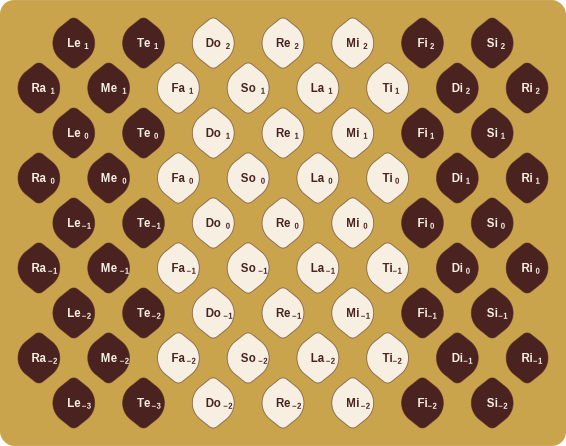
Figure 1 (above). The MeloPresto button-field, with Re₀ at the centre: nine rows, alternately of 7 and 8 buttons, so that a row-pair (two adjacent rows) holds 15. The White Notes are the light buttons and the other notes the dark buttons; every note carries its octave number.
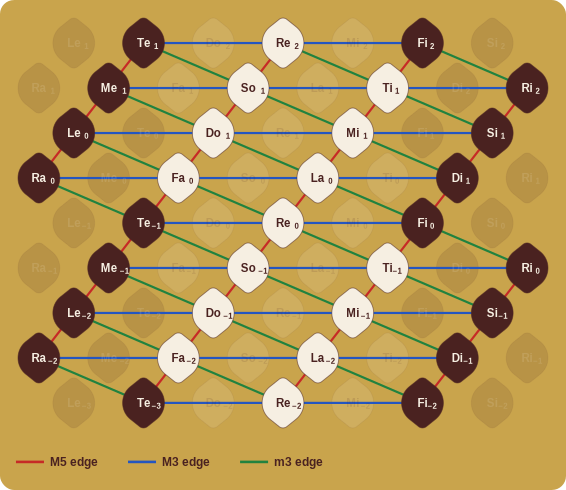
Figure 2 (above). The same buttons, with the tonnetz drawn on them: the note network whose triangles are the major and minor triads, joined by M5/P5 (red), M3 (blue) and m3 (green) edges. Re[Even] is the set of buttons whose lattice position holds an even number of octaves (P8), which includes Re₀ and carries the tonnetz; Re[Odd], every other button, is faded. Note: In MeloPresto, the fifths & fourths are named major and minor; only octaves and unisons are "Perfect".
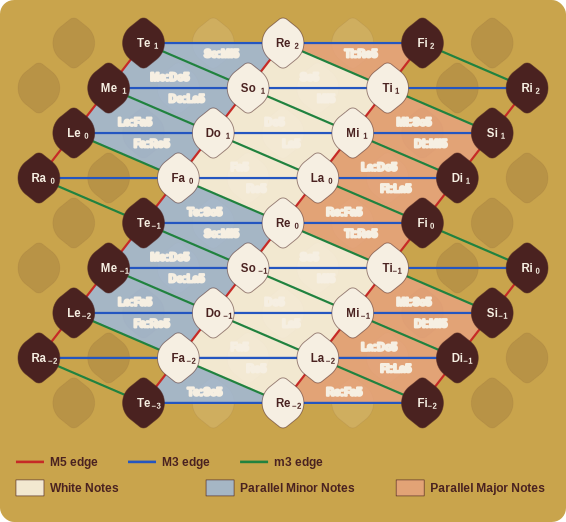
Figure 3 (above). The tonnetz of Figure 2 with each major triad (upward triangle) and minor triad (downward triangle) of three diatonic collections labelled with its MeloPresto chord name: the White Notes (cream), the Parallel Minor Notes (blue) and the Parallel Major Notes (orange). Each triad appears twice, two octaves apart.
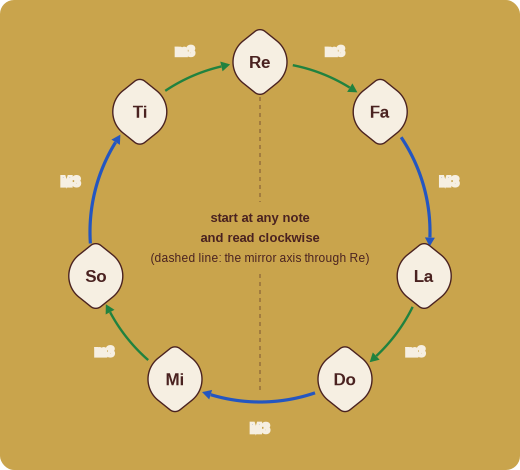
Figure 4 (above). The diatonic Circle of Thirds: the seven White Notes in the order of stacked thirds, Re at the top, each step a major third (M3, blue) or a minor third (m3, green). Reading clockwise from any note gives that note's mode's stack of thirds.
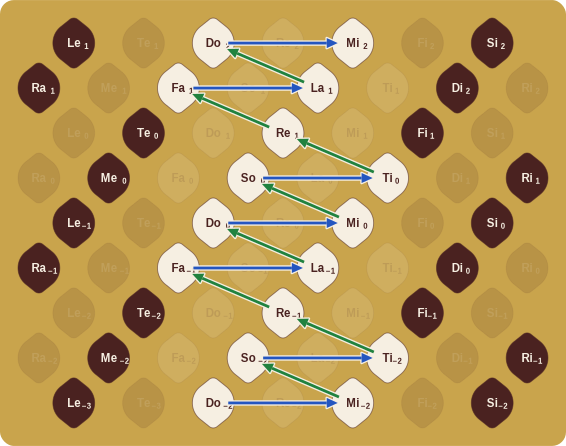
Figure 5 (above). The stack of diatonic thirds on the button-field of Figure 1, from Do₋₂ in the bottom row to Mi₂ in the top row: one arrow for each third, a major third (M3, blue) or a minor third (m3, green). The thirds are those of Figure 4, read clockwise from Do; after seven thirds the stack is on Do again, two octaves higher. Every note of the stack is in Re[Odd], so the buttons of Re[Even] are faded.
0. The axiom: La-based minor
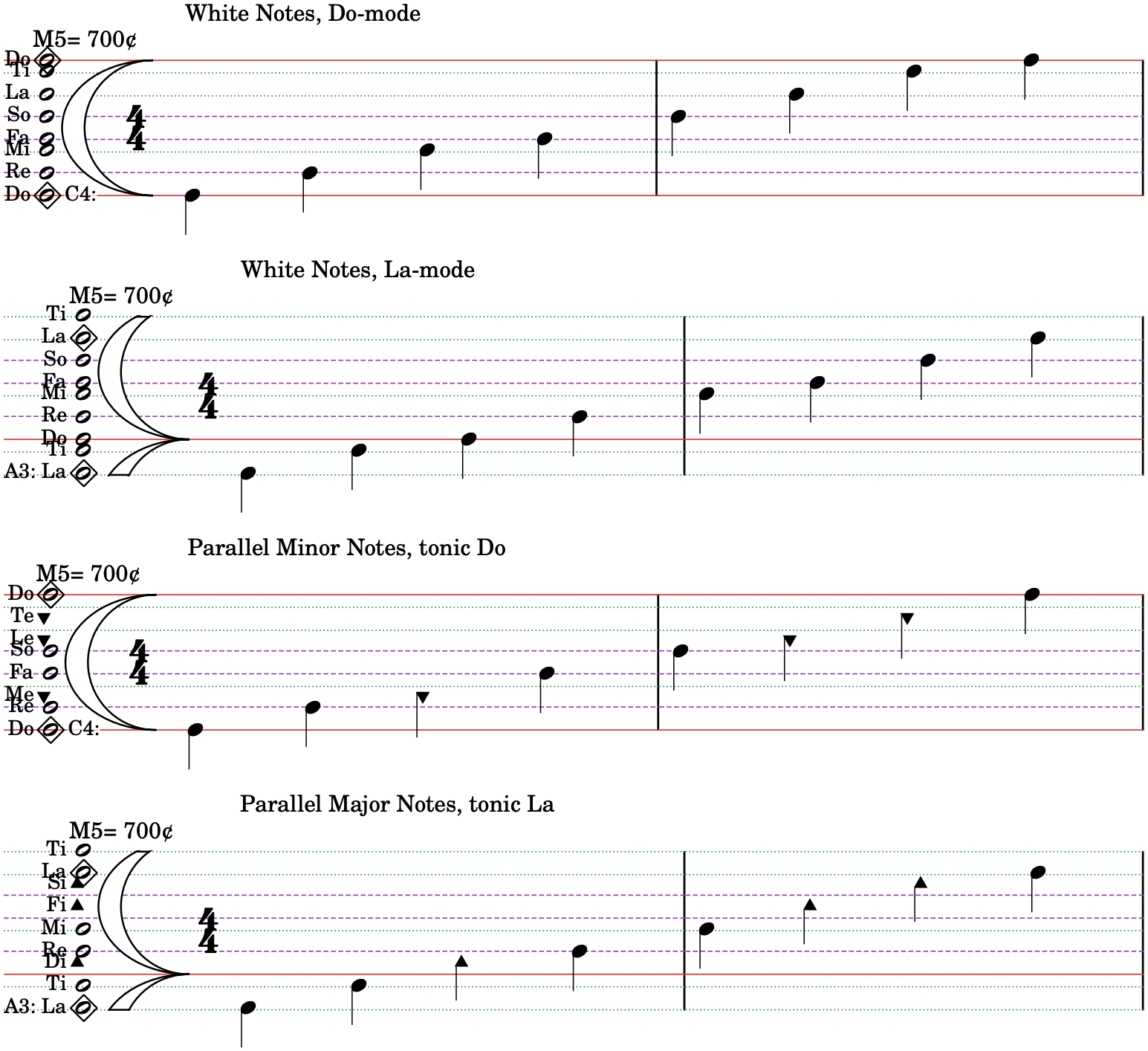
Figure 6 (above). Four MeloPresto Staves rendered by MeloPresto Score, MeloPresto's notation program. The first two staves show the White Notes, with the tonic indicator on Do and then on La; the scale-dot syllables are the same seven. The Parallel Minor Notes (tonic Do) and the Parallel Major Notes (tonic La) are the other two collections of Figure 3.
MeloPresto chord names rest on one choice: movable Do with a La-based minor. The seven syllables
Do · Re · Mi · Fa · So · La · Ti
belong to one invariant diatonic collection: the White Notes. Each names one of its notes. A scale degree is that note's place counted from the tonic: Do is degree 1 when Do is the tonic, and degree 5 when Fa is the tonic. Change the mode and the syllables stay where they are; only the tonic, marked on the MeloPresto Staff by the tonic indicator, moves among them. La-mode's tonic is La; So-mode's is So.
Electronic transposition moves the pitches of the desired key to the White Notes. Modulations generally require a transposition; tonicizations generally do not.
Because "So" always names the same diatonic position in the White Note collection, the stack of diatonic thirds above So is always the same. The shape of SoN, for every degree N, is always the same. Likewise for DoN, ReN, MiN, etc. This is not so when using a Do-based minor, where the minor tonic is called Do and the syllables change with each form of minor: there, "So7" names nothing definite until you also say which mode. La-based minor removes the ambiguity. MeloPresto supports Do-based minor by a secondary means: see the Parallel Minor Notes (Figure 6, third staff), which shows the diatonic scale placed three fifths flatward with Do still the tonic.
1. The canonical stacks
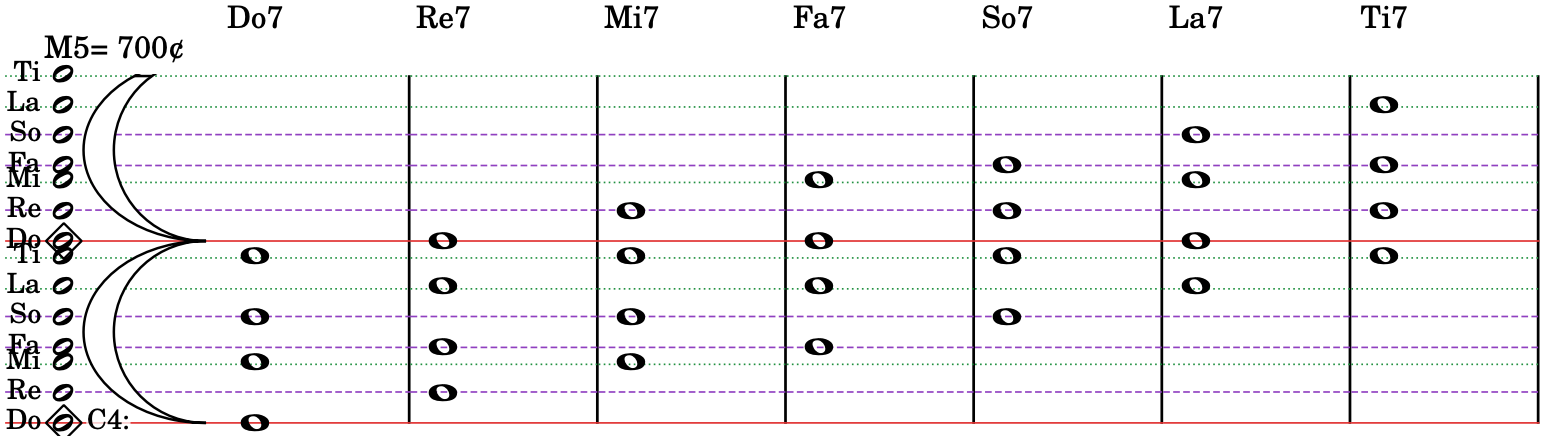
Figure 7 (above). The seven canonical stacks cut after the seventh, one on each White Note, rendered by MeloPresto Score with their MeloPresto names.
Table 1. The canonical stack of each White Note Xx, taken from Figure 4's diatonic Circle of Thirds.
| Xx | 3rd | 5th | 7th | 9th | 11th | 13th |
|---|---|---|---|---|---|---|
| Do | M3 | m3 | M3 | m3 | m3 | M3 |
| Re | m3 | M3 | m3 | M3 | m3 | M3 |
| Mi | m3 | M3 | m3 | m3 | M3 | m3 |
| Fa | M3 | m3 | M3 | m3 | M3 | m3 |
| So | M3 | m3 | m3 | M3 | m3 | M3 |
| La | m3 | M3 | m3 | M3 | m3 | m3 |
| Ti | m3 | m3 | M3 | m3 | M3 | m3 |
Each White Note Xx has one invariant stack of thirds, Xx-mode's canonical stack: the thirds obtained by climbing the White Notes from that note. Each row of Table 1 is read off the Circle of Thirds (Figure 4): start at the row's note, walk clockwise, and write down each third you cross, a major third (M3) or a minor third (m3). The seven rows in Table 1 are seven starting places on the invariant diatonic Circle of Thirds, as embodied on the button-field itself as shown in Figure 5.
The chord XxN is rooted on the solfa note Xx, and includes every odd-numbered degree up to and including its Nth degree. Do5 is M3-m3, the major triad. So7 is M3-m3-m3, the dominant seventh chord; no other White Note's stack begins with that pattern. Ti5 is m3-m3, the diminished triad.
Xx13, the full stack, holds all seven White Notes, for any solfa note Xx.
All well-formed scales.) are symmetric around one note. In MeloPresto, Re is, canonically, the note of symmetry in all such scales. Therefore, on the MeloPresto button-field, every well-formed scale is symmetrical around Re. To emphasize this symmetry, Re is also placed at the top of all circle diagrams, such as Figure 4, making the symmetry around it easier to see.
2. Worked examples
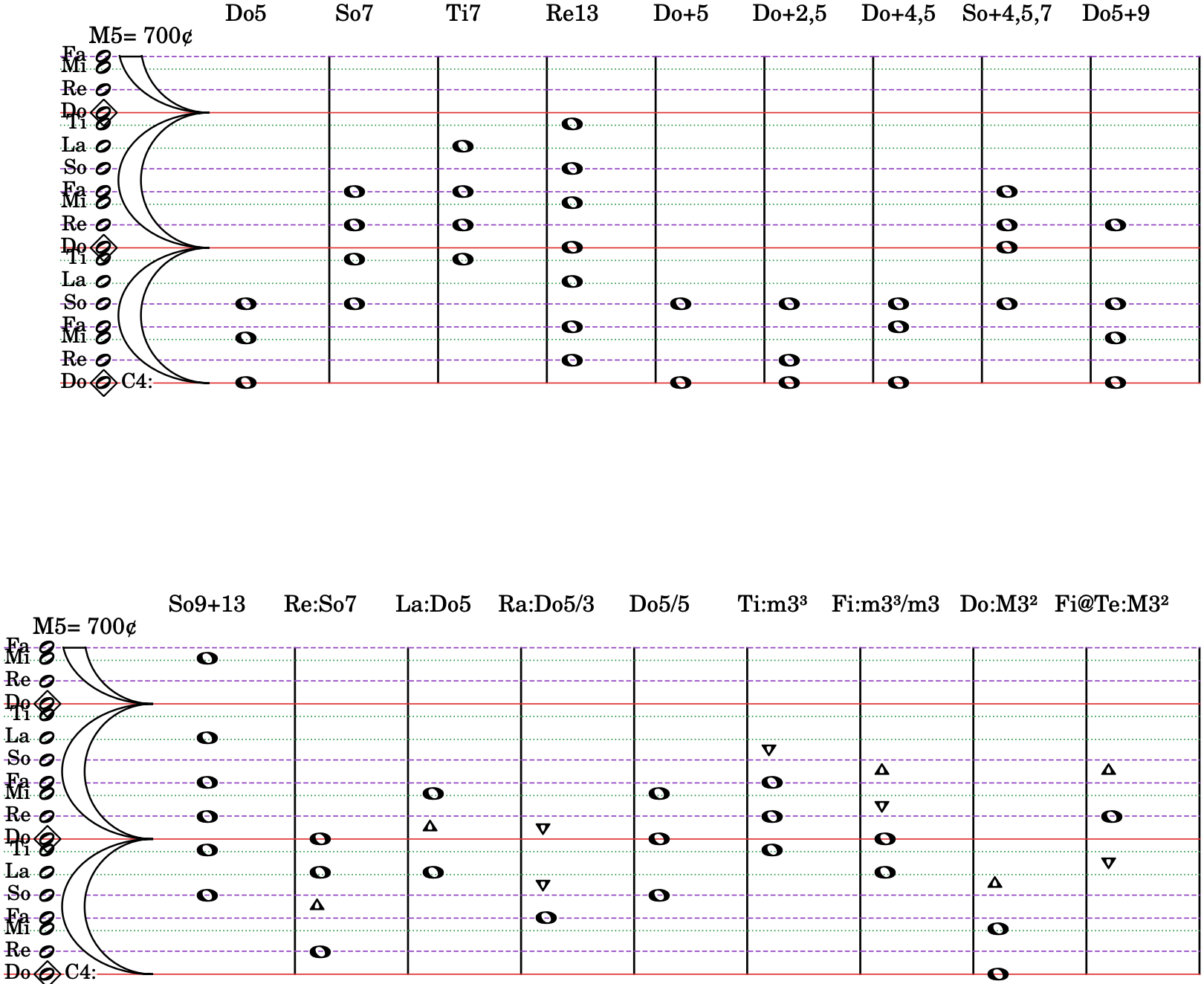
Figure 8 (above). The chords of Table 2 (below), in the same order, rendered by MeloPresto Score with their names above them.
Table 2. Worked examples.
| Name | Notes | What it is |
|---|---|---|
Do5 | Do-Mi-So | major triad |
So7 | So-Ti-Re-Fa | dominant seventh chord |
Ti7 | Ti-Re-Fa-La | half-diminished seventh chord |
Re13 | Re-Fa-La-Do-Mi-So-Ti | full stack of thirds on Re |
Do+5 | Do-So | power chord: Do and its fifth, no third |
Do+2,5 | Do-Re-So | sus2: Re in the third's place |
Do+4,5 | Do-Fa-So | sus4: Fa in the third's place |
So+4,5,7 | So-Do-Re-Fa | dominant seventh chord with a suspended fourth |
Do5+9 | Do-Mi-So-Re | add9: the triad plus the ninth, no seventh |
So9+13 | So-Ti-Re-Fa-La-Mi | dominant thirteenth without the eleventh |
Re:So7 | Re-Fi-La-Do | So's stack applied to Re (secondary dominant; V of V) |
La:Do5 | La-Di-Mi | Picardy third: Do's major triad applied to La |
Ra:Do5/3 | Fa-Le-Ra | Neapolitan sixth |
Do5/5 | So-Do-Mi | cadential six-four |
Ti:m3³ | Ti-Re-Fa-Le | diminished seventh chord on Ti |
Fi:m3³/m3 | La-Do-Me-Fi | diminished seventh chord on Fi, La lowest |
Do:M3² | Do-Mi-Si | augmented triad on Do |
Fi@Te:M3² | Te-Re-Fi | augmented triad on Te, with Fi as its analytical root |
In a name such as So7, the numeral says how far the stack of thirds goes: 5 a triad, 7 a seventh chord, 13 the full stack. In m3³ the superscript counts stacked intervals. A plus sign begins the tail: the part of the name after +, which lists the notes that the cut stack does not hold. A colon applies the stack on its right to the note on its left. A slash names the lowest note. The rules of §§4 and 5 say exactly how each part works.
The numeral takes every third the chord stacks, so the tail never names the next one: So9+13 is a name, and So7+9,13 is not, because So7+9 is So9.
3. Two categories of chord name, and a notation for the path between chords
Table 3. The three notations.
| Notation | Example | What it names |
|---|---|---|
| Category 1: tertian | So7 | So-Ti-Re-Fa, So's canonical stack cut after the seventh |
| Category 2: a stack of identical intervals | Ti:m3³ | Ti-Re-Fa-Le, three m3s stacked on Ti |
| Trail | La5 · Mi:Do5 · L@Si:La5 | three chords in order, and the P/L/R move into the third |
MeloPresto writes harmony in three notations. Two of them name one chord, each in its own category. The two categories are not co-equal:
XxN: Tertian, derived from the scale. The seven canonical stacks come from the White Notes themselves. A name points at one of them:XxN, with any further note carried by the tail (the part of the name after+: the notes that the cut stack does not hold).
iᴺ: A stack of identical intervals. No canonical stack produces the diminished seventh chord or the augmented triad. Such a chord is written as a stack of identical intervals:iᴺ, the interval i stacked N times.
The third notation names no chord. A trail (§11) writes a passage as a sequence of chords, each by its category-1 or category-2 name, and may put before a chord one or more of the letters P, L and R (or, between two seventh chords, a token of §11.7). The letters are the Parallel, Leittonwechsel (leading-tone exchange) and Relative moves of neo-Riemannian theory, which treats the moves between triads as its objects; each turns a triad's triangle over one of its edges on the tonnetz (Figure 3). The letters state the route from the previous chord. In the example, L@Si:La5 reaches Si's minor triad from Mi's major triad by one L move.
4. Category 1: the tertian chord name, XxN
4.1 The parts of a chord name
Table 4. Four names and their parts.
| Name | Analytical root | Application base | Shape | Bass |
|---|---|---|---|---|
So7 | So | So (not written) | So7 | So (not written) |
Re:So7 | Re | Re | So7 | Re (not written) |
Re:So7/3 | Re | Re | So7 | degree 3 of So-mode, applied to Re: Fi |
Fi@Te:M3² | Fi | Te | M3² | Te (not written) |
chord name: [ ! ] [ Rr @ ] [ Yy : ] shape
tertian shape: Xx [ N ] [ + a, b, … ] [ / bass ] · stack of identical intervals: iᴺ [ / bass ], always with Yy :
The placeholders keep one meaning each throughout this document. The shape is the chord shape: the canonical stack of a White Note cut after degree N, with its tail and its bass, or a stack of identical intervals. Xx is the White Note whose canonical stack is played: the shape root. Yy is the note on which that stack starts: the application base. Apply Xx's chord-shape to Yy. Yy and its colon are written only when Yy differs from Xx; a stack of identical intervals has no Xx, so it always writes Yy. Every degree and every interval in a name is read from Xx: the numeral N, each tail element and the bass. None is read from Yy, and none from Rr. The bass names the lowest-sounding note class: a degree D of the shape root's mode when that mode supplies the note, and otherwise the name of the interval from Xx up to that note. The whole shape, with its tail and its bass, is then applied to Yy as one unit. Rr is the analytical root, written when harmonic context establishes a root different from the application base. The optional ! says that the analytical root does not sound; ! is the sign of logical negation. Rr@ and ! change no degree and no interval. The two categories differ only in the shape. A stack of identical intervals has no Xx, so its bass is an interval read from the first note of the stack.
The colon has one meaning: apply the shape on its right to the application base on its left. A category-1 name drops Yy: when the stack starts on its own shape root. A category-2 name always writes the colon, because a stack of identical intervals has no White Note to imply its start; iᴺ alone names the shape before it is placed on any note. The @ is omitted when the analytical root is the application base. The slash is omitted in root position: when the bass is the application base.
In a category-1 or category-2 name only three parts are note syllables: the application base Yy, the shape root Xx and the analytical root Rr. Yy and Rr may be any of the 35 syllables of Table 15 (§10.1); Xx is always a White Note. Every other part of a name is a numeral, a degree of the shape root's mode, or a MeloPresto interval name (MeloPresto Nomenclature, §4) read from the shape root. A note syllable is never written in the tail or as the bass.
Five names, from the shortest to the fullest:
So7: analytical root, application base, shape root and bass are the same note:So.
Re:So7: So's shape applied to Re, which is the analytical root and the bass.
Re:So7/3: As above, with degree 3, Fi, in the bass.
!Re:So7/3: As above, but Re does not sound.
Fi@Te:M3²: the analytical root Fi differs from the application base Te.
4.2 The rules of category 1
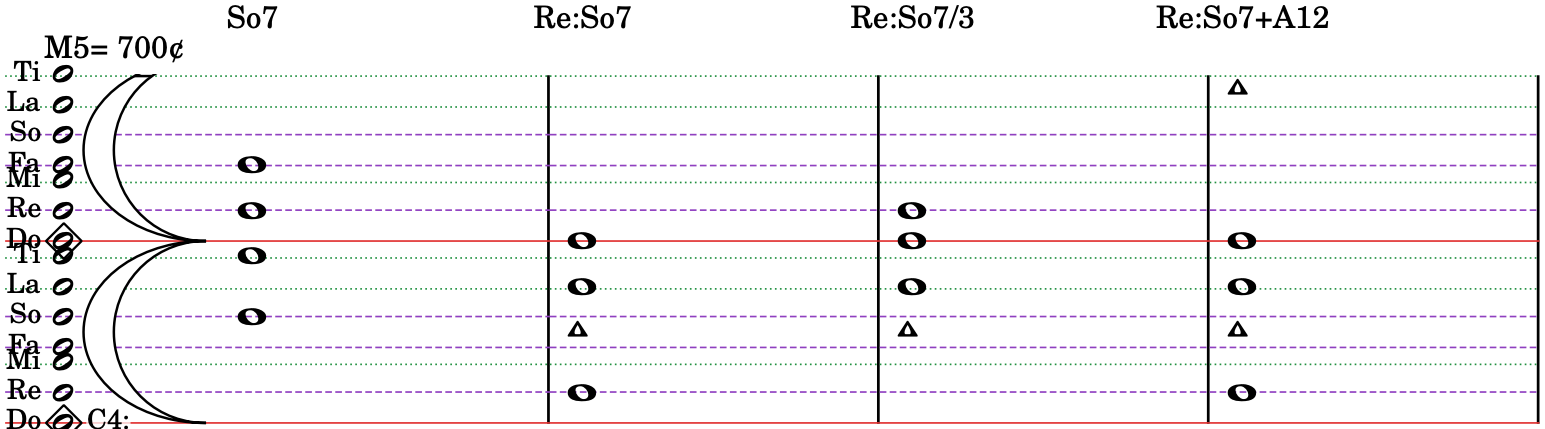
Figure 9 (above). So7; the same stack applied to Re (Re:So7); with its third, Fi, in the bass (Re:So7/3); and with a tail note, the A12 above Re, which is Li (Re:So7+A12). Rendered by MeloPresto Score.
- Xx, the shape root: a White Note [Do Re Mi Fa So La Ti] naming its canonical stack. Every numeral in the name is read in the shape root's mode. In a native chord the stack starts on Xx itself, and
Yy:is omitted. - N, an odd numeral from 3 to 13, cuts the stack after the Nth degree. N is the highest degree the chord reaches by stacked thirds without a gap: the degrees 1-3-5-7-9 on Do are
Do9.Do7+9andDo5+7,9are not names, because each cuts the stack and then adds the next third back in the tail. The name needs no sign for the chord's quality, because the canonical stack already fixes each third. Note count: (N+1)/2. 3 two notes · 5 triad · 7 seventh chord · 9 ninth chord · 11 eleventh chord · 13 all seven White Notes. - + a, b, …, the optional tail: one plus sign, then comma-separated tail elements in ascending order. A tail element is one of two things. A bare numeral names that degree of the shape root's mode. An interval name (
m9,A6,M11, …) names the note that interval above the shape root, and is written only for a note outside the shape root's mode; a note the mode supplies is written as its degree. An interval is numbered as a bare numeral is, at the smallest degree above the stack's numeral (above 1 when no numeral is written):Mi:So7+m10,Mi7+M10(notMi7+M3),Re:So7+A12,Do7+M11,La5+M6. A compound interval keeps its quality letter and adds 7 to its number; doubly augmented and doubly diminished intervals takeAAanddd(Le:Fa5+AA9). No accidental sign ever appears inside a MeloPresto name: a note the mode does not supply is written as an interval, never as an altered degree and never as a note syllable. The numeral N collects the odd degrees (3, 5, 7, 9, 11, 13); the tail can name any degree, odd or even, that the stack skips or does not reach, except the next odd degree after N. The stack may be the shape root alone:Do+5is the power chord, and a suspended note gives the suspended chordsDo+2,5(Do-Re-So) andDo+4,5(Do-Fa-So), with the 2nd or 4th in the third's place. A suspended chord takes further tail elements in the same way:So+4,5,7is the dominant seventh chord with a suspended fourth. - Yy:, the application base: the note on which the stack starts. The whole shape (canonical stack, tail and bass together) is built on the shape root, in the shape root's mode, and then applied as one unit to Yy, every note keeping its interval from the shape root; the syllables of the applied notes follow from those intervals. Every degree and every interval is read from Xx, so the shape reads the same with and without
Yy:.Re:So7+A12builds So's stack and the note an A12 above So, and applies them to Re: that note lands an A12 above Re, which is Li. No colon means native: Xx is the note on which the stack starts, so one never writesSo:So7. - Rr @, the optional analytical root. Absent, the analytical root is the application base (Yy when written, otherwise Xx). Present, harmonic context establishes Rr as the analytical root while the application base is unchanged.
Rr@stands outside the applied shape:Rr@(Yy:Xx). It records an interpretation already established from the composer's spelling and the chord's tonal surroundings; it does not discover or prove that interpretation.Fi@Te:M3²keeps three facts of Grieg's Illusion, Op. 57 No. 3, measures 28 and 57: Fi is the root in the published harmony annotation of the piece (Hentschel, Rammos, Neuwirth and Rohrmeier, Edvard Grieg – Lyric Pieces: A corpus of annotated scores, DOI 10.5281/zenodo.7473578), Te is the application base in the score, andM3²is the exact shape. - !, the optional silent-root marker. It stands first in the name and says that the analytical root does not sound. In
!Re:So7/3the silent root is Re, the application base: the notes are Fi-La-Do, and the bass must be written, because the note that would be the bass is silent. In!So@Ti7the silent root is So, and the notes are Ti's stack, Ti-Re-Fa-La. Strikethrough may show the same fact in teaching material; the plain-text spelling is one!. The tail still states every added sounding note. /D, the bass degree. D is a degree, 1 to 7 [11?], of the shape root's mode. It names a note of the shape, which is applied with the whole shape to the application base. For example, inRe:So7/3, the chord-shape ofRe:So7/3is simply applied toRe. The mode of the piece andRr@do not change this numbering. The slash and the bass are omitted when the bass is degree 1, the note on which the stack starts (Yy when Yy is written, Xx otherwise): the bass ofRe:So7isRe, and the bass ofSo7isSo. An explicit/1is readable, but the written name omits it. A ninth's note class uses/2; the bass says nothing about register. Interval bass: if the shape root's mode does not supply the bass note, write the name of the interval from the shape root Xx up to the bass note.Fa5+A6/A6writes/A6: Ri, the A6 above Fa. In an applied name the interval is still read from Xx, never from Yy: inMi:So7+m10/m3, the m3 above So is Te, and Te applied to Mi is So, the bass. A stack of identical intervals has no shape root, so its bass is always an interval, read from the first note of the stack: inTi:m3³/d7, the note a d7 above the first note ofm3³is the bass, and applied to Ti it is Le. A bass the mode supplies is written as/D, never as an interval, and a note syllable is never written as the bass. Whether the bass note belongs to the chord distinguishes an inversion from a pedal or foreign bass; that distinction does not change which degree or interval is written.- Order of reading: a name is read from the shape outward. The shape
XxN+tail/bassis complete in itself: its numeral, its tail and its bass are all read from Xx. The colon applies the whole shape to Yy.Rr@then names the analytical root of the chord that results, and!says that this root does not sound.Rr@and!change no degree, no interval and no note:Rr@(Yy:(XxN+tail/bass)).
4.3 The chord name and the tonic indicator
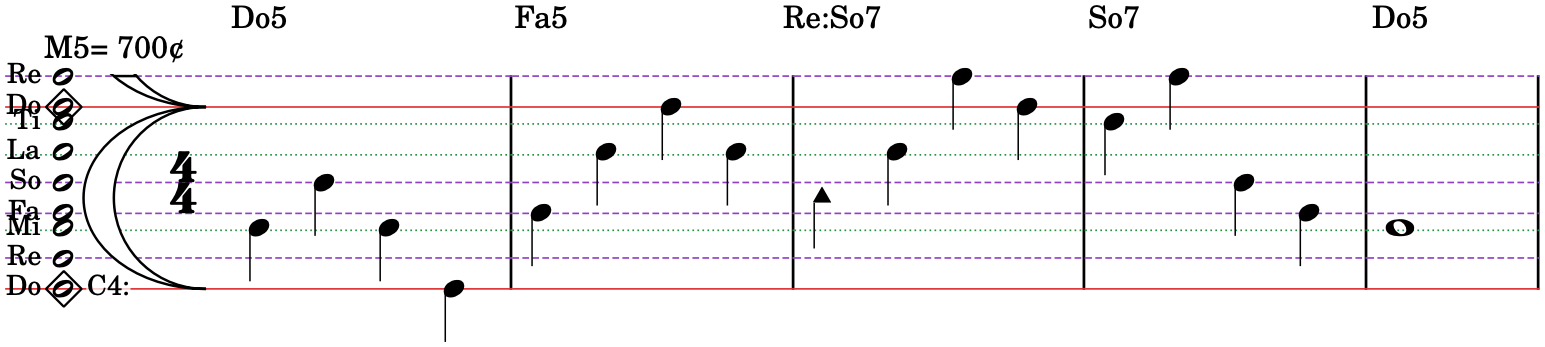
Figure 10 (above). A short melody with Do as the tonic and MeloPresto chord names above it, rendered by MeloPresto Score: Do5, Fa5, Re:So7, So7, Do5. A reader who knows TiMS (the West's Traditional incoherent Music System: conventional Western staff notation and the music theory built on it) would label them I, IV, V7/V, V7, I.
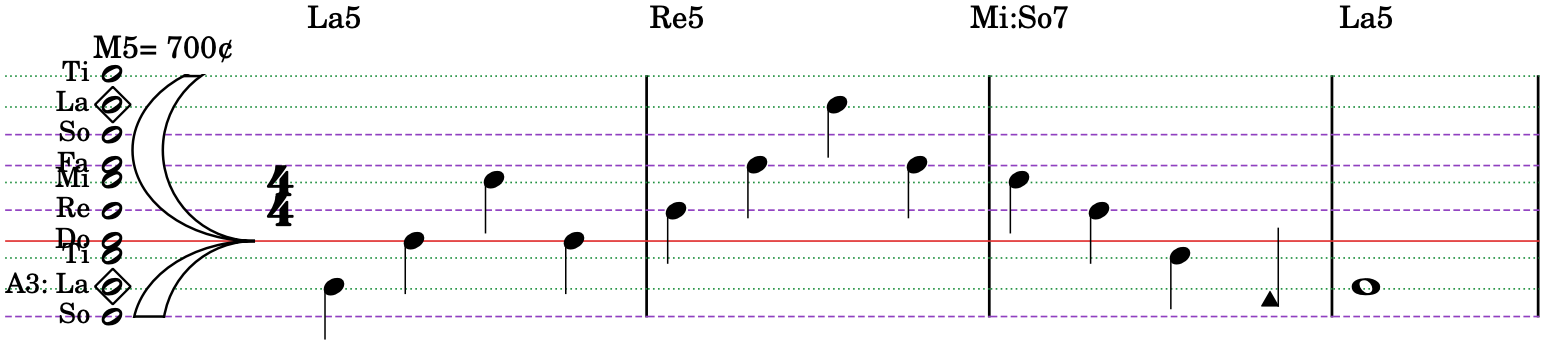
Figure 11 (above). A short melody with La as the tonic, the La-based minor, rendered by MeloPresto Score: La5, Re5, Mi:So7, La5 (in TiMS: i, iv, V7, i). Mi:So7 is So's stack applied to Mi, which brings in Si.
A chord name gives the chord's notes: So7 is the canonical stack of So, whichever note is the tonic. The tonic indicator on the MeloPresto Staff gives the tonic. The two together give the chord's place relative to the tonic. With Do as the tonic, So7 stands on So, degree 5, and Re:So7 is So's stack applied to Re, degree 2. With La as the tonic, Mi:So7 is So's stack applied to Mi, degree 5.
4.4 The Unreasonable Effectiveness of Diatonic Tertian Chord Names in Music
In 1959, the physicist Eugene Wigner presented a lecture titled "The Unreasonable Effectiveness of Mathematics in the Natural Sciences", published the next year. He observed that "The mathematical formulation of the physicist's often crude experience leads in an uncanny number of cases to an amazingly accurate description of a large class of phenomena."
The same is true of diatonic tertian chord names.
Table 5. The share of chords that a tertian chord name names, in four corpora of analysed music. A diminished seventh chord is named Yy:Ti5+d7, and an augmented triad by a tertian name such as Yy:Do3+A5.
| Corpus | Pieces | Chords | Named by a tertian chord name | Named by XxN or Yy:XxN, with or without a bass | Pieces in which a tertian chord name names every chord | Names with a tail of more than three notes | Chords with a note outside the White Notes |
|---|---|---|---|---|---|---|---|
| Distant Listening Corpus, 1650 to 1900 | 997 | 192,183 | 99.27% | 82.9% | 63.8% (636) | 0.36% | 29% |
| Rock Corpus | 200 | 37,403 | 95.4% | 93.2% | 68.5% (137) | none | 14% |
| Jazz Harmony Treebank | 150 | 4,187 | 96.5% | 85.3% | 70.7% (106) | none | 44% |
| Hooktheory | 15,084 | 421,298 | 95.7% | 86.9% | 72.9% (10,997) | 0.14% | 16% |
The Distant Listening Corpus row holds the art music of the Common Practice Era, in works composed between 1650 and 1900; the Rock Corpus holds rock songs, each analysed by two analysts; the Jazz Harmony Treebank holds lead sheets of jazz standards; and Hooktheory holds popular songs analysed by Hooktheory's users, in the Sheet Sage release. Across the four corpora, a tertian chord name names 633,698 of 655,071 chords (96.7%) in 16,431 pieces (Table 5). These corpora include music written in scales other than the diatonic, and their chords often leave the seven White Notes: between 14% and 44% of the chords in each corpus hold at least one note that is not a White Note of the key the source states. The names still reach them, because a canonical stack can be applied to any note (Yy:XxN) and a tail carries any further note.
The plain forms go most of the way: XxN and Yy:XxN, with or without a bass, name between 82.9% and 93.2% of the chords in each corpus. Where a tail is needed it is short. A tail of more than three notes occurs in 0.36% of the names of the Distant Listening Corpus and 0.14% of those of Hooktheory, and never in the other two.
What remains is mostly a limit of the sources, not of the names. A chord whose shape root the source does not state, and to which no rule gives a shape root (§6), takes the ?@notelist name: 1,409 chords in the Distant Listening Corpus, 1,733 in the Rock Corpus, 147 in the Jazz Harmony Treebank and 16,261 in Hooktheory. The two largest groups are the major triad whose application base is Te (Te-Re-Fa in a Do-mode section) and the minor triad whose application base is So (So-Te-Re in a Do-mode section), over whose function analysts divide. In Hooktheory, 1,822 further entries have no name: 1,401 state no notes, of which 1,277 are in two scales that are not diatonic and that the conversion does not read (the harmonic minor and its fifth mode), and 421 are single notes. In the Distant Listening Corpus one chord has no name, because the score and the published analysis disagree about its notes. Each of these is counted in Table 5 as not named by a tertian chord name.
Clearly, an area of important research is improving the analytical toolchain that analyzes music in the West's Traditional incoherent Music System (TiMS) so that it can be named in MeloPresto's chord-naming system.
(The corpora: Hentschel, Rammos, Neuwirth and Rohrmeier, "A corpus and a modular infrastructure for the empirical study of (an)notated music," Scientific Data 12/1, 2025, DOI 10.1038/s41597-025-04976-z; de Clercq and Temperley, "A Corpus Analysis of Rock Harmony," Popular Music 30/1, 2011, pp. 47–70; Harasim, Finkensiep, Ericson, O'Donnell and Rohrmeier, "The Jazz Harmony Treebank," Proceedings of the 21st ISMIR Conference, 2020, pp. 207–215; Donahue, Thickstun and Liang, "Melody transcription via generative pre-training," Proceedings of the 23rd ISMIR Conference, 2022, which released the Hooktheory analyses used here.)
Because of the "unreasonable" effectiveness of diatonic tertian chord names, it is proposed that MeloPresto's Category 2 of chord-names — the Yy:iᴺ form, discussed next — be deleted from MeloPresto.
5. Category 2: the stack of identical intervals, iᴺ
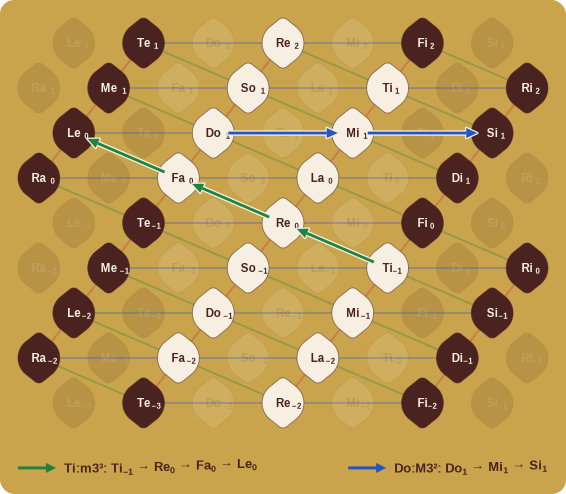
Figure 12 (above). The two stacks of identical intervals on the tonnetz of Figure 2, one arrow per interval: Ti:m3³ climbs three m3s from Ti₋₁ along an m3 line, and Do:M3² climbs two M3s from Do₁ along an M3 line.
Table 6. Three category-2 names.
| Name | Notes | What it is |
|---|---|---|
Fi:m3² | Fi-La-Do | diminished triad, two m3s |
Ti:m3³ | Ti-Re-Fa-Le | diminished seventh chord, three m3s |
Do:M3² | Do-Mi-Si | augmented triad, two M3s |
5.1 Why they stand apart
The diatonic tertian chords can easily name interval patterns that do not occur in the Diatonic Scale via a diatonic Xx-mode's pattern with additions in the tail, such as Ti5+d7. However, that can be unclear, because it implies a specific diatonic role that may not be appropriate, The form Yy:iᴺ is an alternative. In a stack of identical intervals 'i' every member starts the same interval pattern, so no member is singled out and the name has no shape root. On the tonnetz (Figure 12) such a stack is not a triangle but a straight line of notes along an m3 or M3 edge.
A stack of identical intervals still has an exact application base in the score and may have an analytical root established by context. When the application base and analytical root are the same note, Yy:iᴺ suffices. When they differ, Rr@Yy:iᴺ keeps both without changing the colon's meaning.
5.2 The rules of category 2
- A category-2 name has no shape root. Its shape is the stacked interval and its count:
m3ᴺorM3ᴺ. N counts intervals, not degrees, and is at least 2. Ti's own triad, Ti-Re-Fa, is two m3s; it is writtenTi5, the shorter name (§6). Yy:iᴺplaces the shape on an application base. The stack builds upward from Yy, and Yy is the bass unless an interval bass says otherwise. The start and the bass are two independent facts and need two slots. The same bass shows it two ways.Fi:m3³is Fi-La-Do-Me.Fi:m3³/m3is the same four notes with La, the m3 above Fi, lowest: La-Do-Me-Fi, an inversion.La:m3³is a different spelled chord, La-Do-Me-Se, because starting the stack on La changes its top note. Same bass, same stacked interval, different chord; only two slots tell them apart.- A rotation is a choice of Yy; an inversion is a choice of the interval bass; an analytical interpretation is a choice of
Rr@. Starting the stack on a different member gives a different spelled chord, which sounds different except at g = 700 cents, g being the size of the M5 (§5.6). Putting a different member lowest gives an inversion. Naming an analytical root does neither:Fi@Te:M3²keeps the Te-Re-Fi spelling built from Te. The three operations can sound alike at g = 700 and are still different facts.
5.3 The stack of minor thirds
m3²: diminished triad (3 notes); on Ti it is writtenTi5m3³: diminished seventh chord (4 notes)m3⁴: four m3s, returning to the start an octave higher only at g = 700 cents
Ti:m3³ is Ti-Re-Fa-Le. Any member can be the bass while Ti stays the application base: Ti:m3³, Ti:m3³/m3 (Re lowest), Ti:m3³/m5 (Fa lowest), Ti:m3³/d7 (Le lowest). All four are names. Ti:m3³ and Ti:m3³/d7 are written as they stand. The Re and Fa inversions also have the category-1 names Ti5+d7/3 and Ti5+d7/5, which are one character shorter and are therefore the names written (§6): a degree bass is one character, and an interval bass two.
Starting the stack on another member gives a different spelling: Fa:m3³ is Fa-Le-De-Mu.
5.4 The stack of major thirds
M3²: augmented triad (3 notes)M3³: three M3s, returning to the start an octave higher only at g = 700 cents
Do:M3² is Do-Mi-Si. Any member can be the bass while Do stays the application base: Do:M3², Do:M3²/M3 (Mi lowest), Do:M3²/A5 (Si lowest). All three are names. The Mi inversion also has the category-1 name Do3+A5/3, which is one character shorter and is therefore the name written (§6); the other two are written as they stand.
5.5 Side by side
Table 7. The stack of minor thirds and the stack of major thirds.
| stack of minor thirds | stack of major thirds | |
|---|---|---|
| stacked interval | m3 | M3 |
| triad | m3² diminished | M3² augmented |
| four notes | m3³ diminished seventh chord | — |
| stacks that return to the start at g = 700 | m3⁴ | M3³ |
| rotations (choices of Yy) | 4 | 3 |
| inversions per rotation (choices of the interval bass) | 4 | 3 |
5.6 Enharmonic only in 12-edo
Table 8. Twelve fifths and seven octaves at two sizes of the M5.
| Generator g (cents) | Twelve fifths (12 × g) | Seven octaves | Does the octave divide equally? |
|---|---|---|---|
| 700 | 8400 | 8400 | yes |
| 696.578 | 8358.9 | 8400 | no |
Four m3s are twelve fifths downward plus eight octaves, and three M3s are twelve fifths upward minus six octaves. So both stacks return exactly to their start an octave higher only where twelve fifths equal seven octaves, that is, only at g = 700 cents.
The enharmonic pivot, one sounding chord read under two spellings, exists only at g = 700 (12-edo, the tuning that divides the octave into 12 equal steps), where the rotations sound the same pitches in different octaves. The diminished seventh chord's ordinary use, as in Ti:m3³ with Ti leading up an m2 to Do, does not need the octave to divide equally and works at every value of g. Away from g = 700 the rotations sound different, and each choice of application base is a distinct spelled chord.
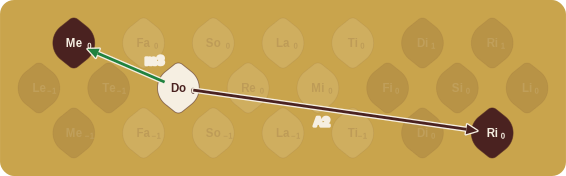
Figure 13 (above). The m3 and the A2 (augmented second) above Do₀ on the button-field of Figure 1, one arrow for each. The m3, three M5s down and two octaves up, ends on Me₀; the A2, nine M5s up and five octaves down, ends on Ri₀. At g = 700 cents Me₀ and Ri₀ sound one pitch, and the two intervals still have two shapes. A tuning is one value of g in the syntonic temperament, the temperament whose period is the octave and whose generator is the M5.
On the MeloPresto button-field each interval — such as the m3 — maintains its invariant shape in every octave, key, and every tuning of the syntonic temperament. Intervals that sound enharmonic in this or that tuning maintain their respective invariant shapes across all tunings.
6. One chord, one name
Table 9. Chords that have a name in each category, and the name written where context establishes no shape root.
| Notes | Category-1 name | Category-2 name | Name written |
|---|---|---|---|
| Ti-Re-Fa | Ti5 | Ti:m3² | Ti5, the shorter |
| Ti-Re-Fa-Le | Ti5+d7 | Ti:m3³ | Ti:m3³: equally long, so category 2 |
| Ti-Re-Fa-Le, Re lowest | Ti5+d7/3 | Ti:m3³/m3 | Ti5+d7/3, the shorter |
| Do-Mi-Si | Do3+A5 | Do:M3² | Do:M3²: equally long, so category 2 |
- One chord, one name. Within category 1 a chord has one name, because the numeral takes every third the chord stacks and the tail never repeats the stack (§4.2): the degrees 1-3-5-7-9 on Do are
Do9, andDo7+9andDo5+7,9are not names. A chord can still have one name in each category (Table 9). Where harmonic context establishes the chord's shape root, the category-1 name on that shape root is written. Where it does not, the shorter by character count is the name written. Each character counts as one, including unicode characters and superscript, som3³is three characters andm9two. The name is counted as written in canonical solfa, whatever note-label pack displays it:Mi:So7+m9, displayed asMi:Sol7+m9in French solfège, counts as the nine characters ofMi:So7+m9, so one chord has one name in every language. - Category 2 wins an exact tie, where context establishes no shape root. The diminished seventh chord on Ti is
Ti:m3³in category 2 andTi5+d7in category 1, six characters each. The augmented triad on Do isDo:M3²in category 2 andDo3+A5in category 1, six characters each. In both cases the category-2 name is written, because it states what the chord is: a stack of identical intervals.Ti5+d7andDo3+A5name a White Note's stack that the chord does not have. - Character count does not choose the analytical root or the shape root. The analytical root is given by the composer or established from the composer's spelling and harmonic context; a published analysis is evidence, not authority over a conflicting score. The shape root is likewise given by the composer or established from the best available analysis of the context. Neither is guessed. Several canonical stacks are alike when cut after the fifth:
La:Do5,La:Fa5andLa:So5spell the same three notes, La-Di-Mi. Context decides which is written:La:So5where the chord leads to Re asSo5leads to Do. Every shape root is two characters long, so character count never overrides the choice.
When the source states no analytical root. Four rules give the analytical root from the chord's notes, the bass, the mode and the next chord. The rules are tried in the order given, and the first rule that applies gives the analytical root.
- Six-four over the dominant. The notes are a triad whose fifth is the bass; the bass is a fifth above the tonic of the mode; and the next chord has the same bass, which is the next chord's application base. The analytical root is the bass. So-Do-Mi before So-Ti-Re in a Do-mode section is
So+4,6, andSo5follows: the fourth and the sixth above So resolve to the third and the fifth. - Augmented sixth. A note an augmented sixth above the bass sounds. The analytical root is the bass. Fa-La-Do-Ri over Fa in a La-mode section is
Fa5+A6(§7). - Stack of thirds. One note, and only one, stacks the chord's notes in thirds with no gap, as a triad, a seventh chord or a ninth chord. The analytical root is that note. Mi-So-Do stacks in thirds from Do alone, so the analytical root is Do and the name is
Do5/3. - The bass. No other rule applies. The analytical root is the bass. Do-Fa-So over Do is
Do+4,5.
A triad with an added sixth has the notes of a seventh chord in first inversion. The stack-of-thirds rule reads the seventh chord: Do-Mi-So-La over Do is La7/3. Where the source states the analytical root Do, the name is Do5+6.
With the analytical root hidden, the four rules give back the analytical root that the source states for 96.6% of the chords of the Distant Listening Corpus (a held-out half of its pieces; chords whose analytical root sounds), 99.8% of the Rock Corpus, 91.4% of the Jazz Harmony Treebank and 98.3% of Hooktheory. In the Jazz Harmony Treebank every chord that the rules read otherwise is a triad with an added sixth.
When the source states no shape root. A major triad has the shape of the canonical stacks of Do, Fa and So; a minor triad and a minor seventh chord have the shape of the canonical stacks of Re, Mi and La. Where the application base is itself one of those White Notes, the name needs no colon and is the shortest: Do-Mi-So is Do5. Elsewhere, in a Do-mode or La-mode section, three rules give the shape root. The rules are tried in the order given, and the first rule that applies gives the shape root.
- The next chord. The application base of the next chord is a fifth below this chord's application base. A major triad takes So, and a minor seventh chord takes Re. In a Do-mode section, Re-Fi-La before a chord on So is
Re:So5, and So-Te-Re-Fa before a chord on Do isSo:Re7. - The parallel mode. The chord takes the White Note that stands at the same place above the tonic of the parallel mode (Table 11). In a Do-mode section the minor triad on Fa is
Fa:Re5; in a La-mode section the major triad on La isLa:Do5. Two chords are excepted, because analysts divide over the function of each: a major chord whose application base is two fifths below the tonic (Te-Re-Fa in a Do-mode section), and a minor chord whose application base is a fifth above the tonic (So-Te-Re in a Do-mode section). Where the source states the Parallel Minor Notes, Table 11 names both. - Fifths above the tonic. A major triad whose application base is two or more fifths above the tonic takes So. In a Do-mode section the major triads on Re, La, Mi and Ti are
Re:So5,La:So5,Mi:So5andTi:So5.
The three rules read a triad or a seventh chord with a tail as its triad or its seventh chord: Me-So-Te-Fa in a Do-mode section is Me:Do5+9. A chord to which no rule gives a shape root takes the ?@notelist name. The three rules do not apply in a So-mode, Re-mode, Mi-mode, Fa-mode or Ti-mode section; there a chord whose shape root the source does not state takes the ?@notelist name.
On a held-out half of the Distant Listening Corpus, the three rules give a shape root to 87% of the chords that need one, and the shape root is the analyst's for 94% of those chords.
- All diatonic chord shapes are named using the White Notes. The simplest example is the tonic chord of Do-mode's parallel minor:
Do:La5.
Table 10. The Parallel Minor Notes from Do and La-mode of the White Notes from La: the same sequence of intervals.
| Degree | 1 | 2 | 3 | 4 | 5 | 6 | 7 |
|---|---|---|---|---|---|---|---|
| Parallel Minor Notes, from Do | Do | Re | Me | Fa | So | Le | Te |
| Interval up to the next degree | M2 | m2 | M2 | M2 | m2 | M2 | M2 |
| La-mode of the White Notes | La | Ti | Do | Re | Mi | Fa | So |
| Interval up to the next degree | M2 | m2 | M2 | M2 | m2 | M2 | M2 |
The Parallel Minor Notes are the diatonic scale placed three fifths flatward, with Do still the tonic: Do, Re, Me, Fa, So, Le, Te. From Do they step M2, m2, M2, M2, m2, M2, M2. That is the interval sequence of La-mode, and of no other mode of the White Notes. So Do sits in the Parallel Minor Notes where La sits in the White Notes: the mode is La-mode started on Do. Do's triad there, Do-Me-So, is an m3 and then an M3, which is the shape of La's triad, La-Do-Mi. Its name is La's chord shape applied to Do: Do:La5.
Every note of the Parallel Minor Notes takes the chord shape of the White Note at the same degree of La-mode (Table 10):
Table 11. The seven triads of the Parallel Minor Notes.
| Degree | 1 | 2 | 3 | 4 | 5 | 6 | 7 |
|---|---|---|---|---|---|---|---|
| Note | Do | Re | Me | Fa | So | Le | Te |
| White Note at that degree of La-mode | La | Ti | Do | Re | Mi | Fa | So |
| Triad | Do-Me-So | Re-Fa-Le | Me-So-Te | Fa-Le-Do | So-Te-Re | Le-Do-Me | Te-Re-Fa |
| Name | Do:La5 | Re:Ti5 | Me:Do5 | Fa:Re5 | So:Mi5 | Le:Fa5 | Te:So5 |
Re's triad, Re-Fa-Le, is two m3s. Here the Parallel Minor Notes establish Ti as its shape root, so its name is Re:Ti5. Where nothing establishes a shape root, the same three notes are written Re:m3² (Table 9).
A chord borrowed from the parallel minor keeps its name. With Do as the tonic, the minor triad on Fa is borrowed from La-mode. Fa is degree 4 of Do-mode; degree 4 of La-mode is Re; so the chord is Fa:Re5, Re's triad applied to Fa.
The Parallel Major Notes work the same way from La: La, Ti, Di, Re, Mi, Fi, Si step M2, M2, m2, M2, M2, M2, m2, the interval sequence of Do-mode. La sits where Do sits in the White Notes, and La's triad, La-Di-Mi, is La:Do5.
- The
?@notelistname. Some chords have no category-1 name and no category-2 name that can be defended. For such a chord,?@followed by the list of its notes is the name. The?stands where the analytical root stands, and says exactly: "a function and a root were looked for, and none was established." The list begins with the sounding bass and continues in ascending degree above it, without separators:?@DoRaFilists Do (the bass), Ra and Fi. A note that has the bass's letter stands first when the note lies sharpward of the bass, and last, as the octave above the bass, when the note lies flatward:?@SiTiRiSolists Si (the bass), Ti, Ri and So. A?@notelistname is a complete name.
When a ?@notelist name may be written. Two conditions must both hold. First, no category-1 name and no category-2 name can be defended for the chord. Second, the search for a function is on record. The record is one of two things: a published expert source (an article, monograph, thesis or dissertation) that gives a reason for assigning the chord no function; or a list of the sources searched, with the finding that none of them discusses the chord. The two kinds of record carry equal weight. Each source is cited by a durable identifier, such as a DOI (Digital Object Identifier), an ISBN (International Standard Book Number), a URN (Uniform Resource Name) or a URL (Uniform Resource Locator).
The ?@notelist name of a chord whose shape root no source states. A ?@notelist name is written on one further ground: the source states no shape root for the chord, and none of the three rules for a chord whose shape root the source does not state gives one. Such a name claims only that the source states no function for the chord and that no rule gives one. Te-Re-Fa in a Do-mode section, with no shape root stated, is ?@TeReFa. A chord of two or more notes that no shape root names at all also takes the ?@notelist name.
What the question mark claims. Every ?@notelist name that an analyst writes claims that the analyst searched and could not assign a function to these notes. Where the record supports it, the name also claims one of two things about the published literature: that the literature does not discuss the chord, or that a published source gives a reason for assigning it no function. No ?@notelist name claims that the chord has no function in the music.
When both conditions hold, the name is owed. Leaving the chord unnamed after a recorded search records nothing, and discards what the search found.
When a ?@notelist name is refused. It is refused when a note of the chord, or its bass, is outside the 35 note classes of Table 15 (§10.1), and when the sounding bass is not known. The name is a list of note classes, so it cannot be written where the notes are not established.
7. The augmented sixth, and the Hendrix chord
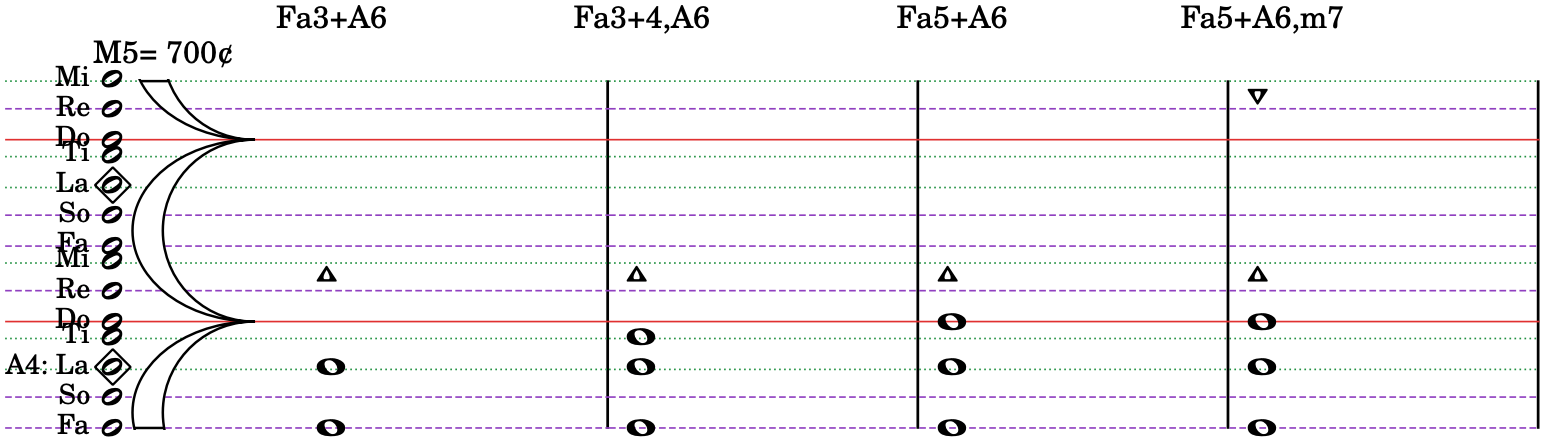
Figure 14 (above). The Italian, French and German sixths and the Hendrix chord in La-mode, rendered by MeloPresto Score with their names.
Table 12. The augmented sixth chords and the Hendrix chord.
| chord | name | notes | tail |
|---|---|---|---|
| Italian | Fa3+A6 | FaLaRi | A6 (Ri) |
| French | Fa3+4,A6 | FaLaTiRi | 4 (Ti, degree 4 of Fa-mode), A6 (Ri) |
| German | Fa5+A6 | FaLaDoRi | A6 (Ri) |
| Hendrix | Fa5+A6,m7 | FaLaDoRiMe | A6 (Ri), m7 (Me) |
A chord that is neither a canonical stack nor a stack of identical intervals still has a category-1 name: a canonical stack cut after the degree its numeral names, plus a tail, in which any note outside the shape root's mode is written as its interval from the shape root. The augmented-sixth family is named this way. There is no category 3. Outside the two categories there is only the ?@notelist name (§6).
An augmented sixth chord is defined by the A6 it contains, which is not a stacked third, so the family can look as if it needs its own notation. It does not. Each member is a category-1 name: Fa's canonical stack cut after the third or the fifth, plus a tail listing the other notes in ascending order. The same construction gives the Hendrix chord.
The mode is La-mode, with La as the tonic. Every augmented sixth is spelled from Fa, the sixth degree (§7.4 says why).
7.1 The core: Fa3+A6
Fa3+A6= Fa-La (Fa's stack cut after the third) + the A6 above Fa (Ri) = FaLaRi
This is the Italian sixth, the augmented sixth chord with the fewest notes. Ri lies outside Fa-mode, so the tail writes it as its interval from Fa, A6.
Ri lies seven fifths sharpward of Re: it is the A2 above Do.
7.2 The members
The Italian is the core: a major third plus an augmented sixth above Fa. The French adds degree 4 of Fa-mode, Ti, which makes two M4s: Fa to Ti, and La to Ri. The German adds the fifth, completing Fa's triad: Fa5+A6. The Hendrix chord adds both the fifth and the m7: Fa5+A6,m7. The German sixth is the Hendrix chord without its m7.
The m7 is written m7, not as a stack numeral. Fa7 reaches Mi, the major seventh above Fa, because Fa's canonical stack is M3-m3-M3; the minor seventh above Fa is Me, which Fa-mode does not supply, so the tail writes it as the interval m7. Me and Ri are two different notes; they sound one pitch only at g = 700 cents, which is what §7.5 is about.
A chord can be written two ways. The name (Fa5+A6) is a recipe: stack, then tail elements in ascending order. The note list (FaLaDoRi) lists the notes by degree above the bass, which is an order that holds at every tuning; the order of the pitches does not, because Ri lies below Me where g < 700, level with Me at g = 700, and above Me where g > 700. Inversion, as everywhere, is the slash: Fa5+A6/5 is the German sixth with Do lowest. The name does not change with inversion.
7.3 Ri, the augmented sixth above Fa
The note the augmented sixth adds and the A2 above Do are the same note class: Ri (Fa + A6 = Do + A2 = Ri). At g = 696.578 cents (quarter-comma meantone, the tuning in which the M3 is the just 5/4), the A6 from Fa to Ri is 965.8 cents, about 3 cents below the just interval 7/4 (968.8 cents).
7.4 Why it is spelled from Fa
The augmented sixth chord resolves by contrary motion onto Mi, the fifth degree of La-mode: Fa down an m2 to Mi, and Ri up an m2 to Mi. It is spelled from Fa because Fa, the sixth degree of La-mode, lies an m2 above Mi. In a mode whose sixth degree lies an M2 above its fifth degree, the chord is built on the note an m2 above the fifth degree, which that mode does not supply.
7.5 The enharmonic pivot
At g = 700 only, Ri and Me are the same pitch. There the German sixth sounds as Fa-La-Do-Me, which is So7 applied to Fa: Fa:So7, or Fa5+m7 with Fa as the shape root. Respelling Ri as Me is the enharmonic pivot of conventional harmony. The same merger reduces the Hendrix chord, Fa-La-Do-Ri-Me, to the same four pitches.
Away from g = 700, Ri (seven fifths sharpward of Re) and Me (five fifths flatward of Re) are different pitches, and neither chord is a dominant seventh chord. On the button-field they are always different buttons: the pivot belongs to the tuning g = 700, which MeloPresto lets the composer use or refuse.
7.6 What the name covers
- Notes: covered, with no new sign and no new category.
- Resolution: not written. The chord's resolution is voice-leading. A chord name names the notes that sound together, as every chord symbol does. The voice-leading is in the staff notation.
8. Scope
Table 13. Two chords, and what their names capture.
| Chord | Name | What the name captures |
|---|---|---|
| German sixth | Fa5+A6 | its notes, fully |
| cadential six-four | Do5/5 | its notes; its identity is in the voice-leading |
MeloPresto's chord-naming rules, as detailed above, name every chord of tonal harmony that is a stack of diatonic thirds, native or applied, with any further note(s) carried by the tail, plus the stacks of minor thirds (m3ᴺ) and the stacks of major thirds (M3ᴺ). The wider claim, that this is the whole vertical vocabulary of the Common Practice period (European art music of about 1650 to 1900), blues, rock and jazz, is a design thesis argued by construction and example; identities built on fourths, upper-structure polychords and voicing are outside it.
Two limits remain. Both are the limits of any purely vertical chord symbol; other systems add signs for voicing and voice-leading (voicing numerals, polychord slashes, voice-leading annotations) that MeloPresto deliberately omits:
- Linear sonorities (cadential and passing six-fours, suspension and pedal chords, common-tone diminished seventh chords) can be spelled but not captured, because their identity is horizontal (voice-leading) and therefore on the staff, not vertical (and therefore in the chord-name).
- Voicing as identity: chords whose identity lies in register, spacing, timbre or spectral fusion (a rootless voicing in fourths; a ♯9 held as a tonic) are named only to their notes, because voicing is deliberately not written beyond indication of the bass.
The augmented sixth is not outside the rules: category 1 names its notes fully (§7). Only its resolution, a voice-leading event, falls under the linear limit, as every chord's resolution does.
9. Why this matters
Table 14. How a chord name writes each part of a chord.
| Part of the chord | How the name writes it | Example |
|---|---|---|
| analytical root | the application base, or Rr@; ! if silent | Fi@Te:M3² |
| shape | the shape of Xx, applied to Yy when Yy is written | Re:So7 |
| bass | /D, a degree of Xx's mode, or an interval from Xx; omitted when the bass is degree 1 | Re:So7/3 |
| voicing | not written; left to the performer | — |
The White Notes supply the canonical note-class names, mode names, and chord shapes. These chord shapes can be derived by direct inspection of MeloPresto button-field. These canonical chord-shapes, on exactly these same White Note buttons, will be played over and over and over simply through playing tonal music of any genre and era. The chord-shapes will be rapidly internalized, allowing them to be applied in borrowings from the White Notes' parallel minor and parallel major. One scale, one Circle of Thirds, and most of tonal harmony's chords are covered. Not all, but most. Add the stacks of m3, M3, etc., and the PLR movements, and you've got a powerful set of rules to name every chord in tonal harmony.
A chord book prints one entry for each combination of root, key, quality and voicing — leading to chord books that brag of including "100,000 chords!". MeloPresto writes the factors: the analytical root and the application base are one syllable unless they differ; neither the mode nor the Reference Pitch appears in the name (the tonic indicator's place among the scale-dots shows the mode, and the Reference Pitch is the pitch Re₀ sounds); the quality is a canonical stack or a short tail; an analytical root that differs from the application base is one @; an inversion is one slash.
Alteration signs measure against one mode. Jazz chord symbols write ♭9, ♯11 and ♭13 relative to the major scale built on the chord's root. MeloPresto names the stack of the chord's own mode directly: Re13, So13 and Ti13 are three different canonical stacks — modes of the Diatonic Circle of Thirds — and none needs an alteration sign.
What a chord name does not write is what happens between chords and how a chord is voiced: voice-leading, the order of chords, voicing, register and timbre.
10. Grammar summary
chord       := [ silent ] [ analyticalroot "@" ] construction
             | notelistname
construction := native | application
notelistname := "?" "@" notelist                    ; the ?@notelist name (§6)
notelist    := syllable syllable { syllable }       ; bass first, then ascending
                                                    ;   degree above the bass
native      := tertian                                ; Xx: the stack starts on Xx itself
application := applicationbase ":" shape              ; Yy ":", written only when Yy differs from Xx
shape       := tertian | intervalstack

; category 1 — derived from the White Notes
tertian     := shaperoot [ numeral ] [ tail ] [ "/" bass ]

; category 2 — a stack of identical intervals
intervalstack := stackedinterval "^" count [ "/" bassinterval ]   ; written m3³ or m3^3

silent      := "!"                                  ; the analytical root does not sound; a bass must
                                                    ;   follow when that root is the application base
analyticalroot := syllable                          ; established from spelling and context
applicationbase := syllable                         ; Yy: the note on which the stack starts
shaperoot   := "Do"|"Re"|"Mi"|"Fa"|"So"|"La"|"Ti"   ; Xx: every degree and every interval is read from it
numeral     := "3"|"5"|"7"|"9"|"11"|"13"            ; where the canonical stack is cut; odd only; the
                                                    ;   highest degree reached by stacked thirds
tail        := "+" tailelement { "," tailelement }  ; ascending; never the degree N+2, which only
                                                    ;   the numeral names: Do9, never Do7+9
tailelement := tailnum | interval                   ; a degree of the shape root's mode, or an
                                                    ;   interval read from the shape root
tailnum     := "2"|"3"|"4"|"5"|"6"|"7"|"9"|"10"|"11"|"12"|"13"
              ; the numeral collects odd degrees; the tail names any other degree, odd or even
              ; an even degree in the third's place is a suspension: Do+2,5 / Do+4,5
              ; a note outside the shape root's mode is written as an interval,
              ;   numbered at the smallest degree above N as a bare numeral is:
              ;   Mi7+M10, Re:So7+A12, Do7+M11, La5+M6
              ; a note the mode supplies is written as its degree, never as an interval
              ; never an altered degree, never a note syllable; NO accidental sign appears in a name
interval    := quality number                       ; MeloPresto Nomenclature §4: m4/M4 and m5/M5 for fourths
                                                    ;   and fifths; A = larger + A1, d = smaller less A1;
                                                    ;   compound = same quality, number + 7
quality     := "dd" | "d" | "m" | "M" | "A" | "AA"
stackedinterval := "m3" | "M3"
count       := integer                              ; number of stacked intervals, at least 2
bass        := bassdegree | bassinterval
bassdegree  := "1"|"2"|"3"|"4"|"5"|"6"|"7"           ; degree of the shape root's mode
bassinterval := interval                            ; simple interval from the shape root Xx up to the bass,
                                                    ;   when Xx's mode lacks the bass: Fa5+A6/A6; in a stack
                                                    ;   of identical intervals, from the first note of the
                                                    ;   stack: Ti:m3³/d7

; bare Xx implies Xx's native shape; Xx may still take N and a tail
; every degree and every interval of a shape is read from the shape root Xx,
;   never from Yy and never from Rr
; the colon means: apply the shape on the right, with its tail and its bass,
;   to the note on the left, the application base
; a stack of identical intervals therefore requires a colon; i^N alone is not placed on any note
; absent analyticalroot@: the analytical root is the application base
; absent bass: the bass is degree 1, the note on which the stack starts; /1 is therefore redundant
; ! marks the analytical root silent, whether that root is the application base or Rr@
; a name is read from the shape outward: Rr@(Yy:(XxN+tail/bass)); Rr@ and ! change
;   no degree, no interval and no note
; changing the application base rotates a stack of identical intervals; changing the
;   bass inverts it; changing Rr@ records an analytical interpretation and does neither
; in these names only Yy, Xx and Rr are syllables; Xx is always a White Note; never pitch-names

; in a ?@notelist name the ? stands where the analytical root stands and says
;   "a function and a root were looked for, and none was established". It is written
;   only when no category-1 or category-2 name can be defended and the search is on record.
;   A ?@notelist name takes no !, no colon, no numeral, no tail and no slash: its first
;   syllable is the sounding bass, and the rest follow in ascending degree.

; ONE CHORD, ONE NAME: where a chord has a name in each category and context establishes
;   no shape root, the shorter by character count, counted as written in canonical solfa whatever pack displays it,
;   is the name written, and the category-2 name when the two are equally long.
;   Analytical root and shape root are facts of context that character count does not choose.
10.1 The 35 note classes
Table 15. The 35 note classes, each with its position on the chain of fifths (nGen).
| White Note | Double-flat (u) | Flat | Natural | Sharp | Double-sharp (y/w) |
|---|---|---|---|---|---|
| Fa | Fu −17 | Fe −10 | Fa −3 | Fi +4 | Fy +11 |
| Do | Du −16 | De −9 | Do −2 | Di +5 | Dy +12 |
| So | Su −15 | Se −8 | So −1 | Si +6 | Sy +13 |
| Re | Ru −14 | Ra −7 | Re 0 | Ri +7 | Ry +14 |
| La | Lu −13 | Le −6 | La +1 | Li +8 | Ly +15 |
| Mi | Mu −12 | Me −5 | Mi +2 | My +9 | Mw +16 |
| Ti | Tu −11 | Te −4 | Ti +3 | Ty +10 | Tw +17 |
The syllables a chord name may use are 35 note classes on the chain of fifths, indexed by nGen: a note class's position on the chain of fifths, counted in fifths (M5) from Re, with Re = 0. Each cell reads name, then nGen. Each step of ±7 in nGen is one further accidental, so the classes fall into bands of seven: naturals at nGen −3 to +3, flats at −10 to −4, sharps at +4 to +10, double-flats at −17 to −11 and double-sharps at +11 to +17, 35 classes from Fu (−17) to Tw (+17). Each column is the previous column ±7, so Table 15 follows from the accidental rule. Reading down any column walks the chain of fifths in single steps: Fa, Do, So, Re, La, Mi, Ti.
The vowel rule: a flat replaces the natural's vowel with e, except that Re, already ending in e, takes a (Ra); a sharp replaces it with i, except that Mi and Ti, already ending in i, take y (My, Ty); a double-flat takes u; a double-sharp takes y, except where the sharp already took y (My, Ty), and there the double-sharp takes w (Mw, Tw).
I would love to find a more-consistent and rational suite of syllables than TiMS' traditional "Do, Re, Mi", but I cannot find or think of one. JALE comes close.
Two boundary notes:
- Scope. The 35 classes govern all chord naming: category-1 names, category-2 names and
?@notelistnames. - Extension. The 14 double-accidental syllables are MeloPresto's own. Other syllable systems (solmization: naming notes by syllables), such as Indian sargam (Sa-Re-Ga-Ma) or the German Tonika-Do system descending from Agnes Hundoegger, have syllable inventories fixed by their own traditions, so these 14 classes have no counterpart there.
11. Trail notation
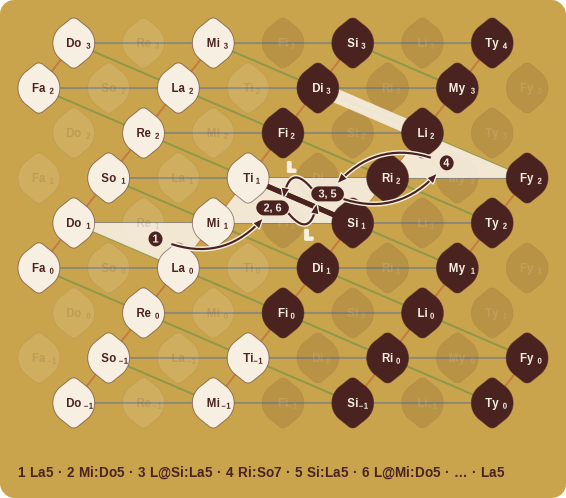
Figure 15 (above). The trail of Schubert's "Auf dem Flusse", measures 16 to 22, on the tonnetz: the numbered stations in order, one arrow for each move from a station to the next, the two L moves (each marked L and holding the dark edge), and the dominant seventh chord Ri:So7 drawn as its own four-note station. The line under the tonnetz is the trail's notation, with the number of its station before each token.
In trail notation the passage is written:
La5 · Mi:Do5 · L@Si:La5 · Ri:So7 · Si:La5 · L@Mi:Do5 · … · La5
Table 16. The tokens of the trail of Figure 15, each with its station and the arrow of the move into it.
| Station | Token | Notes | The move into the station |
|---|---|---|---|
| 1 | La5 | La-Do-Mi | none: the trail starts here |
| 2 | Mi:Do5 | Mi-Si-Ti | arrow 1 to 2; no flip word |
| 3 | L@Si:La5 | Si-Ti-Ri | arrow 2 to 3, marked L: over the dark edge Si-Ti |
| 4 | Ri:So7 | Ri-Fy-Li-Di | arrow 3 to 4; no flip word |
| 5 | Si:La5 | Si-Ti-Ri | arrow 4 to 5, back to station 3; no flip word |
| 6 | L@Mi:Do5 | Mi-Si-Ti | arrow 5 to 6, marked L: back over Si-Ti to station 2 |
Everything before this section names one chord at a time; a trail names a passage's harmonic route. A trail is a reading of the music.
11.1 Worked example: Schubert, "Auf dem Flusse"
Winterreise D 911 No. 7, "Auf dem Flusse", measures 16 to 22, in E minor, so La = E. The trail reads the passage chord by chord, except that it omits the chord on the first beat of measure 20 (Di:Re7) and writes no inversions.
La5 is the tonic station, La's minor triad. Mi:Do5 is Do's major triad applied to Mi, the major triad a fifth above the tonic, with no flip word because the trail asserts no P/L/R route for that move. L@Si:La5 reaches Si's minor triad by L: from Mi:Do5 (Mi-Si-Ti), hold the edge Si-Ti and move Mi down an m2 to Ri. Ri:So7 is So7 applied to Ri, the dominant seventh chord a fifth above Si, with no flip word. Si:La5 returns to Si's minor triad. L@Mi:Do5 crosses the same Si-Ti edge back by the same L. The … stands for the E major section that follows; La5 returns at measure 39.
Classification: type (b), closed circuit with window excursion (§11.11). Out and home both travel by L across the Si-Ti edge, Ri:So7 carries a note (Fy) outside the naming window, and the trail returns to its first triangle. Checksum (§11.12): net displacement 0 fifths; mode kept (minor out, minor home).
11.2 The tonnetz, and what a trail is
A trail writes a passage's harmonic route across the tonnetz (Figures 2 and 3): the network, unbounded in every direction, whose triangles are the major and minor triads, two triangles being neighbours when their triads share an edge of two notes. A trail is a sequence of stations, one per chord in the order played, each placed on the tonnetz and named by its ordinary MeloPresto name (§§1 to 10).
11.3 Seventh chords take their own stations
A dominant seventh chord or a half-diminished seventh chord is a station of its own: it is placed on the tonnetz as the whole four-note chord and named by its ordinary MeloPresto name, not reduced to a triad inside it. This follows Adrian Childs ("Moving beyond Neo-Riemannian Triads," Journal of Music Theory 42/2, 1998), who moves seventh chords with transformations that hold two notes invariant, as the edge-flips of §11.5 do. The alternative, deletion, reads a dominant seventh chord as its lower major triad and a half-diminished seventh chord as its upper minor triad. The station treatment fits music written in seventh chords, such as the chains of seventh chords in Ravel's Jeux d'eau, which deletion would reduce to triads. The example of §11.1 writes the dominant seventh chord of the new key as its own station, Ri:So7.
11.4 The token grammar
The trail productions extend the grammar of §10:
trail  := token { "·" token }
token  := [ flip "@" ] chord
flip   := plrword | seventhop
plrword  := ( "P" | "L" | "R" )+
seventhop := ( "F" | "T" ) "." pairinterval pairinterval
pairinterval := "m3" | "M3" | "m5" | "M5" | "m7"

; chord is the chord name of §10, unchanged, drawn from the
;   35 classes Fu..Tw (§10.1)
; the flip slot is optional; when present, the flip WORD is the full
;   transform relating THIS chord to the PREVIOUS one
; reading direction is DECLARED first-applied-left: wherever flip letters
;   compose, the leftmost applies first
The · separates consecutive stations. The @ of the flip slot cannot be confused with the analytical-root @: an analytical root is a two-letter syllable, a capital and a lowercase letter (Rr@), while a flip is capitals from P, L and R or a token that begins F. or T.. So L@Si:La5 reads as the flip L into the station Si:La5, PLP@Si:La5 as the word PLP into it, and a token may carry both (L@Fi@Te:M3²: flip L into the station Fi@Te:M3²).
The reading direction is declared: neo-Riemannian writing uses both left-to-right and right-to-left composition, so MeloPresto declares first-applied-left once.
11.5 The flip slot: a word of the letters P, L, R
Table 17. The three edge-flips.
| Letter | Move | Holds | Example |
|---|---|---|---|
| P (Parallel) | same root, other quality | root and fifth (M5) | Do5 ↔ Do:La5 |
| L (Leittonwechsel, "leading-tone exchange") | the root of a major triad moves down an m2 | the m3 above the third | Do5 ↔ Mi5 |
| R (Relative) | the fifth of a major triad moves up an M2 | root and third (M3) | Do5 ↔ La5 |
The flip slot carries the flip word: one or more letters, composed first-applied-left, that make up the full move from the previous chord to this one. Neo-Riemannian theory (NRT) is the branch of transformational music theory that treats the moves between triads, rather than the triads themselves, as its objects; its three basic moves are the edge-flips of the tonnetz, each holding one edge of a triad's triangle and turning the triangle over it.
Flips and transpositions. Every basic operation in the flip slot is one of two kinds: a Flip (F.: holds a pair of notes, changes quality, undoes itself) or a Transposition (T.: keeps quality). P, L and R are the abbreviations of the three triadic flips: P = F.M5A1 (hold the M5 pair, one note moves by A1), L = F.m3m2 and R = F.M3M2. They are always written as the single letters; F.M5A1, F.m3m2 and F.M3M2 only define them. Transposition tokens exist only for the three seventh-chord moves of §11.7. The dominant move D is two flips, RL on a major triad and LR on a minor triad (§11.13), and every larger move is a word of several letters, first-applied-left.
The letters are P, L and R only, but the slot holds a word made of them. The literature's other letters are excluded as letters: S (SLIDE), N (Nebenverwandt, German for "neighbour-related") and H (hexatonic pole) are three-letter P/L/R words and are written out; D (Dominant) is not an edge-flip but a transposition, whose P/L/R spelling depends on the triad's quality (§11.13).
A word of several letters asserts more than the relation between the two sounding chords: it asserts the route, the path of edge-flips across the tonnetz, read first-applied-left, through the triangles each letter reaches. Those intermediate triangles do not sound. When an intermediate chord does sound, it gets its own token. So PLP@… claims a route through two silent intermediate triangles, while the same three flips over three sounding chords are three tokens.
Each of P, L and R undoes itself, which is what lets one edge carry a trail out and home (§11.1).
11.6 Flips at seventh boundaries
Where exactly one of the two stations is a dominant seventh chord or a half-diminished seventh chord, a flip word asserts the unique shortest route of edge-flips between stand-in triads, not between the sounding chords: a dominant seventh chord stands in as the major triad on its own root (So7 as So5), and a half-diminished seventh chord as the minor triad on its upper three notes (Ti7 as Re5). The word is written in capitals, P, L and R always, with no extra marker: the station name shows that the station is a seventh chord, and so that the flip is measured between stand-ins. Where the shortest route between the stand-ins is not unique, or is longer than three flips, the slot stays empty. The station itself stays the whole seventh chord (§11.3); only the flip word is measured from the stand-in.
11.7 Seventh to seventh: the Childs operations
Table 18. Childs's nine operations and their tokens.
| Childs | Token | Kind |
|---|---|---|
| S2(3) | F.m7m3 | Flip |
| S3(2) | F.m3m7 | Flip |
| S3(4) | F.m3M3 | Flip |
| S4(3) | F.M3m3 | Flip |
| S5(6) | F.M5m5 | Flip |
| S6(5) | F.m5M5 | Flip |
| C3(2) | T.m3m7 | Transposition |
| C3(4) | T.m3M3 | Transposition |
| C6(5) | T.m5M5 | Transposition |
Where both stations are dominant or half-diminished seventh chords, the flip slot carries one of the nine transformations of Adrian Childs, "Moving Beyond Neo-Riemannian Triads: Exploring a Transformational Model for Seventh Chords," Journal of Music Theory 42/2 (1998), pp. 181–193, DOI 10.2307/843872.
Childs's labels (his p. 185): an S transform holds two notes while the other two move by a half step (an A1 or an m2; Childs works in 12-edo, where the two are one size) in similar motion; a C transform moves them in contrary motion; the first subscript is the interval class (the interval in half steps, counted up to octave and inversion) of the two held notes, and the subscript in parentheses that of the two moving notes. The nine operations are all the moves of two notes by a half step each among dominant and half-diminished seventh chords (his Figure 5, p. 186). All six S transforms change quality and undo themselves; the C transforms keep quality, C6(5) undoes itself, and C3(2) and C3(4) undo each other (p. 185).
The token spells the operation's kind letter, a dot, the held pair's MeloPresto interval name, then the moving pair's. The kind letters are F for a Flip, the four-note counterpart of the P, L and R edge-flips, and T for a Transposition. Childs's S and C record the direction of the moving notes (similar or contrary), which follows from the pairs; F and T record the operation's kind: flips undo themselves, transpositions compose and invert. So F.m3M3@ is Childs's S3(4), and T.m5M5@ his C6(5). The six F operations undo themselves; T.m5M5 is the one transposition that undoes itself, and T.m3m7 and T.m3M3 undo each other. The kind letters change with the language of an edition (in German: W, for Wechsel, "exchange", and T, for Transposition); the operations are the same in every edition. The dot matters: a chord name never contains one, so a token such as T.m3M3 cannot be read as a chord name. The interval names are MeloPresto's: the traditional perfect fifth is M5, the perfect fourth m4 and the traditional diminished fifth m5. Childs's interval-class digits therefore read: 2 is the m7 between root and seventh, 3 the m3, 4 the M3, 5 the M5 between root and fifth, and 6 the m5 between the third and seventh of a dominant seventh chord. The token does not say whether each moving note steps by A1 or m2: the spelled station names on either side already fix it. The slot is filled only when exactly one Childs operation relates the two stations; otherwise it stays empty.
11.8 The enharmonic equals, and TORUS orbits
· Re=Mu ··TORUS[T.m3M3x4:Fa-Re-Ti-Si→Le]
Trail notation is always spelled; closure under a tuning is a property of the path, never of a move. Where an operation's held notes are respelled on the page (the sound holds, the spelling changes), the respelling is written on the separator as an enharmonic equals in note syllables: · Re=Mu ·, or a bare ·=· where several notes are respelled at once. The flip word beside it stays, because the move between the sounding chords is real. Moves computed from spelling (P/L/R words, stand-in flips) never carry one; only moves computed from sounding pitches can.
A cycle of one operator that returns to its start only through such a respelling is a TORUS orbit, written with the return shown as a respelling:
TORUS[<operator> x <period> : <unfolded roots> → <respelled landing>]Ravel's Jeux d'eau orbit (bar 69) is TORUS[T.m3M3x4:Fa-Re-Ti-Si→Le]: four half-diminished seventh chords stepping by m3, the fourth root spelled Si in the unfolded chain and written Le in the score. The token shows only note names. The arithmetic behind it is the accumulated d2 (the diminished second, seven octaves minus twelve M5s), which is zero only in the tunings that close the orbit. Four m3s differ from one octave by exactly one d2, and so do three M3s, so an orbit by m3 or by M3 accumulates one d2 per lap. A cycle with no accumulated d2 is a circuit, closed on the lattice itself, and takes no token. A TORUS token is written beside the trail, never as a station in it, because it describes a span of stations.
11.9 Stacks of identical intervals as stations
A trail writes a stack of identical intervals as a station, by its ordinary name, with no new signs. The neighbouring tokens record how the trail enters and leaves it.
11.10 Stations with no flip word
Table 19. Three tokens and their flip words.
| Token | Flip word | Why |
|---|---|---|
L@Si:La5 | L | one edge-flip reaches it |
Mi:Do5 (after La5) | none | a move by fifth is not an edge-flip |
Ti:m3³ | none | a stack of identical intervals is not a triangle |
Every chord, tertian or not, is a station named by its ordinary name. When no flip word describes the move into a station (a stack of identical intervals, a chord that is not built in thirds, any move the P/L/R letters do not produce), the token is the bare chord name. An empty flip slot asserts only that no flip-word route is claimed from the previous station. A ?@notelist name can stand as a station: the trail places it and does not interpret it.
11.11 Trail classification
Every trail is classified as one of five types, and its outward and homeward parts are reported separately, since the route out need not equal the route home:
- (a) Closed circuit within the naming window: the trail returns to its first triangle, and no station's notes leave the naming window, the 21 classes from Fe to Ty of §10.1.
- (b) Closed circuit with window excursion: the trail returns to its first triangle, but some station's notes leave the window. There is NO enharmonic identification: the tonnetz is unbounded, so an excursion is real distance, not a respelling; the 35 classes from Fu to Tw (§10.1) keep the excursion's stations nameable without merging spellings.
- (c) Drift trail: a net displacement of ±12 fifths, which sounds closed only at g = 700 (12-edo, the tuning in which twelve fifths close into a circle); on the tonnetz the trail ends twelve fifths from where it began.
- (d) Hybrid: mixed behaviour, for example a closed section joined to a drifting section.
- (e) Open trail: the trail neither returns to its first triangle nor drifts a full twelve fifths. It ends somewhere other than where it began, at a distance neither zero nor twelve.
Types (a) to (d) describe complete routes: a whole piece or a whole closed section, where "did it come home?" has an answer. An excerpt opens and closes in the middle of the music, so a trail of an excerpt is ordinarily (e) open.
11.12 The checksum (optional)
Table 20. The checksum of the trail of §11.1.
| Trail | Net displacement | Mode |
|---|---|---|
| §11.1, Schubert | 0 fifths | kept (minor out, minor home) |
A trail may carry a checksum: net displacement in fifths, and whether the trail ends in the mode it began in. It is the counterpart, in fifths, of Julian Hook's Uniform Triadic Transformations (UTTs), "Uniform Triadic Transformations," Journal of Music Theory 46/1–2 (2002): 57–126, DOI 10.1215/00222909-46-1-2-57, which label each triadic move with a mode-change sign and a transposition amount; the checksum totals the same two quantities over a whole trail, counted in fifths rather than half steps.
The checksum is optional: a trail without it is complete. A correct checksum shows that a reading is consistent with its classification (§11.11); it does not show that the reading is right.
11.13 Scholarly grounding
- The three moves descend from the Schritt/Wechsel (German: step/exchange) system of Arthur von Oettingen (Harmoniesystem in dualer Entwickelung, 1866) and Hugo Riemann (Skizze einer Neuen Methode der Harmonielehre, 1880).
- Their modern formalization as operations on triads is David Lewin's, under the names REL, PAR and LT: Generalized Musical Intervals and Transformations, Yale University Press, 1987, ISBN 978-0-300-03493-6, pp. 175–180.
- The single letters P, L, R are Brian Hyer's ("Reimag(in)ing Riemann," Journal of Music Theory 39/1, 1995: 101–138), and Richard Cohn's parsimony program ("Neo-Riemannian Operations, Parsimonious Trichords, and Their Tonnetz Representations," Journal of Music Theory 41/1, 1997: 1–66) works with P, L, R and their compounds.
- D is NOT a P/L/R word. Lewin's DOM is transposition down a fifth; the P/L/R word that does it to a major triad (first R, then L) fails on a minor triad, which needs first L, then R, so no single P/L/R word does D to both. That is one reason §11.5 excludes D from the letters.
- The checksum's precedent is Hook 2002 (§11.12).
- The treatment of seventh chords (§11.3, §11.7) is Adrian Childs's extension of the same program beyond triads.